September 24

Podcast | Political Communication

Podcast | Political Communication

Published 24 September 2019

Welcome to the fourth instalment of our podcast. This episode focuses on implied constitutional freedom of political communication by employees on social media and the recent High Court decision in the case Comcare v. Banerji.

You can listen to the podcast below, or by clicking the links to subscribe on your preferred streaming service:

Spotify: https://spoti.fi/2YiRq5K

Google Podcasts: http://bit.ly/2LFbjxQ

Pocket Casts:  https://pca.st/c2V2

Breaker: http://bit.ly/32PIkgk

Radio Public: http://bit.ly/2K1rZwq


The content of this podcast is general in nature and provides a summary of the issues covered. It is not intended to be, nor should it be relied upon, as legal or professional advice for specific employment situations.

Working Knowledge recommends that specialist legal advice should be sought about specific legal issues.

September 4

Podcast | Flexible Work Arrangements

Podcast | Flexible Work Arrangements

Published 4 September 2019

Welcome to the third instalment of our podcast. In this episode we discuss the parameters of flexible work, who is eligible, and managing requests from employees for flexible work arrangements.

You can listen to the podcast below, or by clicking the links to subscribe on your preferred streaming service:

Spotify: https://spoti.fi/2YiRq5K

Google Podcasts: http://bit.ly/2LFbjxQ

Pocket Casts:  https://pca.st/c2V2

Breaker: http://bit.ly/32PIkgk

Radio Public: http://bit.ly/2K1rZwq


The content of this podcast is general in nature and provides a summary of the issues covered. It is not intended to be, nor should it be relied upon, as legal or professional advice for specific employment situations.

Working Knowledge recommends that specialist legal advice should be sought about specific legal issues.

August 19

Podcast | Genuine Redundancy

Podcast | Genuine Redundancy

Published 19 August 2019

Welcome to the second instalment of our podcast. Episode 2 discusses genuine redundancy in the unfair dismissal jurisdiction.

You can listen to the podcast below, or by clicking the links to subscribe on your preferred streaming service:

Spotify: https://spoti.fi/2YiRq5K

Google Podcasts: http://bit.ly/2LFbjxQ

Pocket Casts:  https://pca.st/c2V2

Breaker: http://bit.ly/32PIkgk

Radio Public: http://bit.ly/2K1rZwq


The content of this podcast is general in nature and provides a summary of the issues covered. It is not intended to be, nor should it be relied upon, as legal or professional advice for specific employment situations.

Working Knowledge recommends that specialist legal advice should be sought about specific legal issues.

July 25

Pocast | Casual Employment

Pocast | Casual Employment

Published 25 July 2019

Welcome to the first instalment of our podcast. Episode 1 covers the issues around casual employment and the recent changes to the law that have created a level of confusion amongst employers and employees alike.

You can listen to the podcast below, or by clicking the links to subscribe on your preferred streaming service:

Spotify: https://spoti.fi/2YiRq5K

Google Podcasts: http://bit.ly/2LFbjxQ

Pocket Casts:  https://pca.st/c2V2

Breaker: http://bit.ly/32PIkgk

Radio Public: http://bit.ly/2K1rZwq


The content of this podcast is general in nature and provides a summary of the issues covered. It is not intended to be, nor should it be relied upon, as legal or professional advice for specific employment situations.

Working Knowledge recommends that specialist legal advice should be sought about specific legal issues.

July 16

Do I really have to go?

Everyone has those appointments, tasks or events that they just don’t want to show up for. However, there are some things you must bite the bullet and attend.

It should go without saying that one of those times is when your attendance is required by a court.

It appears this common sense has not transferred to required attendance by the Fair Work Commission (FWC).

Though the FWC is a tribunal and not a court, it is still essential that you attend when required to do so. Non-attendance at a FWC conciliation or hearing never goes well for the party not in attendance.

If you believe that by not attending, that no order can be made against you, you are very much mistaken. A Member of the FWC has the power to decide on a matter in the absence of a required attendee.

It is also incorrect to believe, that by not participating in the process, any orders made against you will be unenforceable. Non-compliance with an order of the FWC is a criminal offence. The other party can seek enforcement through the Federal Circuit Court of Australia or the Federal Court of Australia. These courts can in addition to enforcement order a monetary fine for non-compliance.

Case Examples of Non-Attendance

Staying in a similar area of law as my colleague’s blog last week, there are two unfair dismissal case examples from this year, that show some people need to be reminded to participate in the FWC process.

The first is Giuseppe Trigilia v Di Carlo Civil Construction Pty Ltd atf Di Carlo Drainage Trust [2019] FWC 1832. In this case the employer, Di Carlo Civil Construction Pty Ltd, did file a Form F3 – Employer response to unfair dismissal application. Yet the employer did not attend the two conciliations, file any further material, attend the telephone Mention hearing, nor attend the arbitration conference/hearing. The FWC was unsuccessful in attempts to contact Di Carlo Civil Construction Pty Ltd using the details provided on the Form F3.

In the second case, Farzana Khan v Oakleigh Fruit Barn [2019] FWC 3458, Oakleigh Fruit Barn did not file a Form F3. The FWC, after multiple attempts, managed to speak to Mr Darren of Oakleigh Fruit Barn before the conciliation. Mr Darren informed the FWC that he had not received any notification of the matter. Mr Darren confirmed his telephone number for the conciliation and receipt of another copy of the documentation. After multiple attempts to contact Mr Darren for a second conciliation the matter proceeded to a hearing. Mr Darren did not file any material for the hearing nor respond to any attempt by the FWC to contact Mr Darren by telephone calls, email, sms messages and mail. Mr Darren did not attend the hearing.

Deputy President Masson concluded that by not participating Mr Darren showed that he had made a conscious decision not to participate. Though Mr Darren had the opportunity to respond he failed to do.

By not filing any materials or attending the employer organisations’ were unable to respond to the submissions and evidence of the Applicants nor provide additional evidence or explanations. The evidence of the Applicants was left unchallenged and accepted by the FWC Members.

In both cases it was found that the employees had been unfairly dismissed. They were both awarded monetary compensation. The compensation amount may have been reduced if the Respondents had filed material or attended to lead evidence that the amount would have impacted the viability of their business in accordance with section 392(2)(a) of the Fair Work Act.

Reminder

It is always best to file forms and material and attend the FWC when required to do so. No matter what you think of the matter or the prospects of success. By doing so it gives you the opportunity to respond to the submissions of the other party, provide additional information or explanations for your case. It might also provide you with the opportunity to decrease the amount of any monetary compensation orders made.

If the reason for considering non-attendance is the cost of representation you can represent yourself in the FWC. Nevertheless, it is strongly advised that you have a representative to assist you by explaining the process and helping you prepare.

June 14

Refusal to Employ

Employers are required to walk a tight-rope every time they hire a new employee.  

The Fair Work Provisions that prohibit discrimination against prospective employees are broad.  However, in reality, these situations are almost impossible to enforce.

Discrimination is an essential aspect of the human condition. We ‘discriminate’ thousands of times a day.  When we choose the foods we are going to eat, the people we spend our time with, and, at which exact moment to cross the road. Having the capacity and confidence to discriminate between our life options is what keeps us safe, and makes us successful humans.

When making employment decisions, however, including recruitment decisions, those characteristics that represent ‘lawful’ discrimination and ‘unlawful’ discrimination are not always easy to navigate.  Requiring an employee to have ’30 years’ experience’ is not the same as requiring that person to be ‘over 45’, but there is an essential nexus between these two states that is hard to ignore in practical terms.  On the other hand, there is nothing unlawful about choosing a candidate on the basis of lack of experience, on the grounds that they will potentially cost less, especially in the event that a Modern Award provides that someone below the age of 20 can be paid a lower minimum rate.  Yet, refusing to hire someone because they are not ‘young’ is clearly unlawful.  

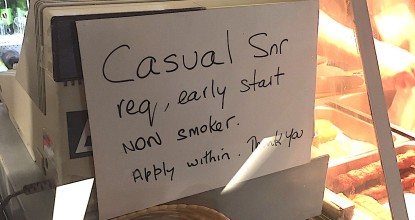
Employers who actively advertise for ‘Junior’ or ‘Senior’ employees flirt dangerously with this subtle distinction.

The Fair Work Act provides broad protections against this type of unlawful decision, by prohibiting adverse action against prospective employees on unlawful discriminatory grounds.  Under section 342, adverse action against a prospective employee includes ‘refusing to employ’ that employee, and under section 351 this adverse action cannot be taken for reasons that include race, colour, sex, sexual orientation, age, physical or mental disability, marital status, family or carer’s responsibilities, pregnancy, religion, political opinion, national extraction or social origin.”

The unlawful reason needs to be only one of the reasons, and once an allegation is made, the employer would bear the onus of ‘proving otherwise’.

Most of these protections are obvious ‘no brainers’. They protect us from discrimination on the grounds of the key personal characteristics that we all should know are plainly and obviously wrong.  They are supported by concurrent state and commonwealth antidiscrimination legislation, which are based on international law. Section 351, however, goes a little bit further than the domestic and international antidiscrimination standard, and the full scope of the provision is not easy to pin down, especially when we look critically at some of the more ‘marginal’ characteristics. This is especially the case when the reverse onus is taken into account.  For example, would it be unlawful for the ACTU to ‘refuse to employ’ a candidate because they discover, in a pre-interview social media screen, that the candidate ‘likes’ Cory Bernardi on Facebook – clearly a ‘political opinion’?

Is it ok for an interviewer to ask a candidate ‘What are your responsibilities outside of work? Are you able to take on overtime shifts at short notice?’ and then base part of the decision on this answer?  Or could this be regarded in some circumstances as a refusal to employ based on ‘family or carer’s responsibilities’.   Put more broadly, does it become unlawful to factor ‘availability’ into this decision.  Clearly, this is a relevant employment consideration, yet also dangerously discriminatory in certain circumstances.  Would an employer, seeking an employee with high level logical ability, discriminate against a prospective employee on the basis of what that employer considered to be an illogical religious belief expressed during an interview?

In many cases, disaggregating ‘lawful’ from ‘unlawful’ considerations is actually a lot more difficult than most of us are comfortable admitting to ourselves.

Perhaps my favourite example is my hypothetical law school grads, Bobby and Robbie. They are the final two candidates competing for a position in a traditional top tier firm.  Their resumes, academic transcripts, and experience are virtually identical. Bobby was a high school rugby union star from Knox Grammar. Robbie was a high school rugby league star from St Gregory’s Campbelltown.  The defining moment in Bobby’s successful interview with the Senior Partner was the conversation on the way out the door, when the Senior Partner asks Bobbie his thoughts on the Wallabies’ chances in the next world cup.  As an employment litigator and rugby league fanatic, I would take some pleasure in cross examining the Senior Partner in the Federal Court, where he would be required by the Fair Work Act to discharge a positive onus to prove that ‘social origin’ was not a substantial and operative factor that actuated his decision to favour Bobby over Robbie.  

But perhaps what is most appealing about this hypothetical (aside from the fact that it has brought the topic of rugby league to a conversation where it is not typically invited) is that it illustrates the key practical reality of this issue.  This court case would never happen, because these decisions are made privately and confidentially, and many of these prejudices are buried deeply. The High Court have recently held that ‘unconsious’ decisions cannot offend the general protections provisions. It is not possible to positively prove something that you don’t consciously know.  The sad truth is that the most deeply held biases are held on this level.

Pre-employment discrimination protections exist in a broad and comprehensive manner in Australia, but they are almost impossible to rely upon.  Even with the reverse onus in play, these forms of discrimination are almost impossible to prove, even if you have a knowledge or reasonable suspicion that it has occurred.  

The mind of the pre-employment discriminator is a closed book, and they have been playing this game for along time.