June 14

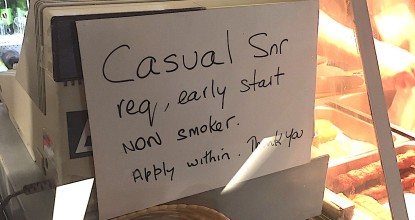
Refusal to Employ

Employers are required to walk a tight-rope every time they hire a new employee.  

The Fair Work Provisions that prohibit discrimination against prospective employees are broad.  However, in reality, these situations are almost impossible to enforce.

Discrimination is an essential aspect of the human condition. We ‘discriminate’ thousands of times a day.  When we choose the foods we are going to eat, the people we spend our time with, and, at which exact moment to cross the road. Having the capacity and confidence to discriminate between our life options is what keeps us safe, and makes us successful humans.

When making employment decisions, however, including recruitment decisions, those characteristics that represent ‘lawful’ discrimination and ‘unlawful’ discrimination are not always easy to navigate.  Requiring an employee to have ’30 years’ experience’ is not the same as requiring that person to be ‘over 45’, but there is an essential nexus between these two states that is hard to ignore in practical terms.  On the other hand, there is nothing unlawful about choosing a candidate on the basis of lack of experience, on the grounds that they will potentially cost less, especially in the event that a Modern Award provides that someone below the age of 20 can be paid a lower minimum rate.  Yet, refusing to hire someone because they are not ‘young’ is clearly unlawful.  

Employers who actively advertise for ‘Junior’ or ‘Senior’ employees flirt dangerously with this subtle distinction.

The Fair Work Act provides broad protections against this type of unlawful decision, by prohibiting adverse action against prospective employees on unlawful discriminatory grounds.  Under section 342, adverse action against a prospective employee includes ‘refusing to employ’ that employee, and under section 351 this adverse action cannot be taken for reasons that include race, colour, sex, sexual orientation, age, physical or mental disability, marital status, family or carer’s responsibilities, pregnancy, religion, political opinion, national extraction or social origin.”

The unlawful reason needs to be only one of the reasons, and once an allegation is made, the employer would bear the onus of ‘proving otherwise’.

Most of these protections are obvious ‘no brainers’. They protect us from discrimination on the grounds of the key personal characteristics that we all should know are plainly and obviously wrong.  They are supported by concurrent state and commonwealth antidiscrimination legislation, which are based on international law. Section 351, however, goes a little bit further than the domestic and international antidiscrimination standard, and the full scope of the provision is not easy to pin down, especially when we look critically at some of the more ‘marginal’ characteristics. This is especially the case when the reverse onus is taken into account.  For example, would it be unlawful for the ACTU to ‘refuse to employ’ a candidate because they discover, in a pre-interview social media screen, that the candidate ‘likes’ Cory Bernardi on Facebook – clearly a ‘political opinion’?

Is it ok for an interviewer to ask a candidate ‘What are your responsibilities outside of work? Are you able to take on overtime shifts at short notice?’ and then base part of the decision on this answer?  Or could this be regarded in some circumstances as a refusal to employ based on ‘family or carer’s responsibilities’.   Put more broadly, does it become unlawful to factor ‘availability’ into this decision.  Clearly, this is a relevant employment consideration, yet also dangerously discriminatory in certain circumstances.  Would an employer, seeking an employee with high level logical ability, discriminate against a prospective employee on the basis of what that employer considered to be an illogical religious belief expressed during an interview?

In many cases, disaggregating ‘lawful’ from ‘unlawful’ considerations is actually a lot more difficult than most of us are comfortable admitting to ourselves.

Perhaps my favourite example is my hypothetical law school grads, Bobby and Robbie. They are the final two candidates competing for a position in a traditional top tier firm.  Their resumes, academic transcripts, and experience are virtually identical. Bobby was a high school rugby union star from Knox Grammar. Robbie was a high school rugby league star from St Gregory’s Campbelltown.  The defining moment in Bobby’s successful interview with the Senior Partner was the conversation on the way out the door, when the Senior Partner asks Bobbie his thoughts on the Wallabies’ chances in the next world cup.  As an employment litigator and rugby league fanatic, I would take some pleasure in cross examining the Senior Partner in the Federal Court, where he would be required by the Fair Work Act to discharge a positive onus to prove that ‘social origin’ was not a substantial and operative factor that actuated his decision to favour Bobby over Robbie.  

But perhaps what is most appealing about this hypothetical (aside from the fact that it has brought the topic of rugby league to a conversation where it is not typically invited) is that it illustrates the key practical reality of this issue.  This court case would never happen, because these decisions are made privately and confidentially, and many of these prejudices are buried deeply. The High Court have recently held that ‘unconsious’ decisions cannot offend the general protections provisions. It is not possible to positively prove something that you don’t consciously know.  The sad truth is that the most deeply held biases are held on this level.

Pre-employment discrimination protections exist in a broad and comprehensive manner in Australia, but they are almost impossible to rely upon.  Even with the reverse onus in play, these forms of discrimination are almost impossible to prove, even if you have a knowledge or reasonable suspicion that it has occurred.  

The mind of the pre-employment discriminator is a closed book, and they have been playing this game for along time.    

September 22

Same-sex marriage and religious protections at work. Are we getting the full story?

The topic of same-sex marriage has been hotly debated since the Government announced its plans for a postal plebiscite on the issue. Most in favour of change recognise this as a human rights issue, and most against change consider it an attack on religion, free speech, or other undefined ‘values’. But there has been very little discussion about workplace rights, which is typically a very complex and deeply personal area of our lives. The ‘freedom’ of the metaphorically devout cake decorators has once again been high on the agenda. But how does religious freedom currently affect the 99.99% of Australian workers that don’t bake?

One of the most out-spoken people on this topic has been former Prime Minister Tony Abbott who (in case you didn’t know) is a very vocal proponent of maintaining the current definition of marriage between a man and a woman. Amongst other reasons, Mr Abbott has claimed that since we haven’t seen the proposed legislation, voting yes will be signing a “blank cheque” and we cannot be sure of how this will affect freedom of speech and religious protections.

34848442_s

However, this is simply not the case with respect to religious protections contained within the Fair Work Act. Under section 351 of the Fair Work Act, religious organisations such as churches enjoy wide-ranging exemptions which allows them to take adverse action against employees on the basis of sex, pregnancy, marital status, political opinion, sexual orientation and other characteristics. Adverse action can include dismissing an employee, altering an employee’s position to their disadvantage and injuring an employee in their employment. This discrimination is allowed provided it is in “good faith in order to avoid injury to the religious susceptibilities of adherents of that religion”. In other words, a church is allowed to fire someone if they are gay or if they are married if it goes against the teachings of that church. Changing the definition of marriage in the Marriage Act to include same-sex marriage will have no effect on the exemptions provided to churches since they can already discriminate on the grounds of sexual orientation and marital status.

Two recent examples relating to employer’s views on same-sex marriage highlight the special position that churches have compared to ordinary employers. The Australian Catholic Church announced in August that even if same-sex marriage was legalised, they would dismiss staff of the same sex who marry. The Archbishop of Melbourne, Denis Hart, indicated that the Catholic Church would still expect all its teachers, nurses and other employees to follow Catholic beliefs and teachings when it comes to marriage. The Archbishop of Perth, Timothy Costelloe is on record as saying that “like all other employers, the Catholic Church should be able to ensure its values are upheld by those who choose to work for the organisation”. Even if same-sex marriage was legalised, the Catholic Church would not face an adverse action claim on the grounds of discrimination if it did decide to fire staff because of their sexual orientation and/or marital status due to the religious exemptions provided to them under the Fair Work Act.

Whilst Archbishop Costelloe maintains the right of the Catholic Church to “ensure its values are upheld by those who choose to work for the organisation”, this is not something enjoyed by ordinary employers who cannot just fire someone based on protected attributes, such as sexual orientation, marital status, political opinion, etc. Madlin Sims the owner of the business Capital Kids Parties dismissed a worker Madeline because she had added a Coalition for Marriage “It’s OK to vote No’ Facebook filter to her profile picture. Ms Sims justified the dismissal on the grounds that, amongst other things, “homophobic views being made public are detrimental to the business”. The Fair Work Ombudsman has announced they are seeking to interview both Madeline and Ms Sims to determine if there has been a breach of the Fair Work Act. It is likely Madeline was an independent contractor (and not protected by the adverse action provisions in section 351) but if it turns out she was an employee, then Ms Sims could potentially be facing an adverse action claim on the grounds of discrimination. Madeline’s views on same-sex marriage likely constitute a political opinion and under section 351, Ms Sims is prevented from taking adverse action (which includes dismissing someone) because of their political opinion.

Rightly or wrongly, religious organisations are currently exempt from adverse action claims on the grounds of discrimination and can freely hire and fire people on the basis of their sexual orientation, marital status, sex, etc. Despite Mr Abbott’s comments to the contrary, changing the definition of marriage will have no effect on the religious protections enjoyed by churches under the Fair Work Act.

April 12

‘Because’ – four reasons why a simple word has confused employment lawyers for a generation

There are over 200,000 words in the Fair Work Act 2009 (Cth).  It is longer than the New Testament. It is a ‘plain English statute’, which means most of the words are ordinary.  The word ‘and’ is used 3,099 times, ‘or’ is used 5,030 times, and the word ‘if’ is used 1,478 times.  The word ‘because’, used 197 times, has created significantly more controversy than any other, and has occupied Australian Unions and Employment Lawyers for probably close to a million billable hours since 2009 alone.  It is a simple word, used and understood by most Australian toddlers, but its legal nuance has baffled some of Australia’s great legal minds.

This is because part 3-1 of the act provides employees with ‘General Protections’ against unlawful harm.  Specifically, employers are prohibited from adversely treating employees ‘because’ of certain protected types of employee conduct, or protected employee characteristics.  Most notably, section 340 protects employees against adverse action ‘because’ they exercise rights at work, section 346 protects them against adverse action ‘because’ of their connection or involvement in industrial activity, and seciton 351 protects them against adverse action ‘because’ of discriminatory grounds, such as sex, gender, race, national origin, or family responsibilities etc.12647893 - word on keyboard made in 3d

Numerous aspects these provisions have received attention in the Courts, but none more than the operation of the word ‘because’.  There are several reasons for this.  Firstly, section 360 provides that if there are multiple reasons for an action, the unlawful reason only has to be included as ‘one of the reasons’.  Secondly, section 361 reverses the onus, which means that once alleged, an employer must prove that the reasons did not include the alleged unlawful reason.  With this enactment, Parliament have clearly intended for these protections to contain a very broad understanding of the word ‘because’.   Not surprisingly, employers, and subsequently courts, have pushed back.  The High Court attempted a definitive statement in Board of Bendigo Regional Institute of Technical and Further Education v Barclay [2012] HCA 32 (‘Barclay’). This case involved an employee who was both a manager, and a senior union official.  He had been suspended for sending an email that accused a number of colleagues of serious misconduct, in falsifying records for the purposes of an audit.  The allegation was made that the suspension ‘because’ of his union involvement, in breach of section 346.  At first instance in the Federal Court, it was held that the reasons for the suspension were the misconduct only.  The Full Federal Court overturned this decision, claiming that unconscious factors played a part in the decision.  The High Court disagreed.  In a detailed judgment, the Court addressed a number of issues, and provided us with a comprehensive statement regarding the meaning of ‘because’.  However, the decision is so comprehensive, it is almost unhelpful.  Our state of knowledge is greatly improved by Barclay, however our understanding of ‘because’ has not particularly improved following this decision.  Barclay is a conceptual smorgasbord, and parties now help themselves to whichever parts of the judgment that their case finds most appetising.  In just about every General Protections dispute I have been involved in, Barclay has been relied upon heavily by both sides in argument.  There are four key issues that have fallen from this:

1. How significant does a reason need to be, before it is considered to be an ‘included reason’?

In drafting section 360, it was the clear intention of parliament to suggest that a prohibited reason only needs to be included as one of the reasons.  However, the conduct still has to be ‘because’ of that reason, at least to some extent.    In the Explanatory Memorandum to the Act, it was explained that the pre-existing common law has been adopted, and that the reason does not have to be the ‘sole or dominant’ reason. It may be a ‘subsidiary’ reason, but it must be an ‘operative or immediate’ reason.  In Barclay, the High Court describe this enquiry as being the thing that ‘actuated’ the decision. Multiple reasons can exist, but unless the prohibited reason ‘actuated’ the decision, there is no breach.  In some ways, this adopts the traditional ‘but for’ test.   If the reason had not been present, would the decision still have been made?  Following Barclay however, the status of cumulative reasons (ie a ‘the straw that breaks the camel’s back’), is a little unclear.  This is especially given the next major issue – whether or not an ‘unconscious’ reason can be unlawful.

  1. Can reasons be ‘unconscious’?

41826443 - concept of man screaming inside his opened headA basic understanding of the human condition recognises that we don’t always consciously know why we do the things that we do.  From an intuitive or ‘common sense’ point of view, it is reasonable to presume that sub-conscious factors will have a ‘substantial and operative’ impact on a decision maker.  However, the High Court has held that this is not the case as a question of law.  The reverse onus in section 361 is of fundamental importance to this.  The Court noted that the onus was on a decision maker to ‘prove otherwise’ once an allegation is made.   As a question of logic, how can a decision maker ‘prove’ that they did not act for an unconscious reason?  This would be an impossible burden.  It follows therefore, that the notion of ‘because’, relates to the conscious, subjective, reasons for the decision.

But this doesn’t help us when a reason is a ‘straw that breaks the camel’s back’.  If we presume that the pre-existing load on a camel are the unconscious reasons, and the ‘straw’ is the conscious reason that ‘actuates’ the decision, then a variety of unconscious unlawful decisions contributing to the decision cannot be held to be breaches of the general protections.  Conversely, if the unconscious pre-existing ‘load’ is lawful, but the ‘straw’ is a minor, unlawful reason, which on its own would not have been an ‘operative’ reason, then the employer will not be able to discharge the onus, and the Act will have been breached.

  1. Can a mistaken reason be unlawful, if the mistake was genuine and made in good faith?

Further difficulties arise when we recognise that the subjective reason which actuated a decision can also be made in error.  In CFMEU v Anglo Coal [2015] FCAFC 157, an employee had an application for annual leave refused, because too many employees were on annual leave at the same time.  The employee made threats that he would phone in sick.  When the day in question came, the employee was actually sick.   The employee was dismissed for dishonesty, and an allegation was made that the employee was dismissed for exercising a workplace right, in contravention of the General Protection. The majority of the Full Court of the Federal Court found that the employee was not dismissed because he exercised a workplace right. It was found that at the time of terminating the employment, Anglo Coal were not aware that he had been legitimately sick and that he was dismissed because he was dishonest and his conduct irreparably broke down the employment relationship.  The court held that whilst the decision might be unjust as the employee had been legitimately sick when he took personal leave, there was no evidence that Anglo Coal had terminated the employee because he actually took personal leave.

Again, applying the ‘subjectivity’ principles in Barclay, we see that the court’s application of the General Protections provisions is not concerned with the ‘justness’ of outcomes, but the motivating reasons behind the conduct of decision makers.  A mistake, made in good faith, is therefore not unlawful.  Analogous to the public law principles of Administrative law, it could be argued that the General Protections in practice have become less concerned with the protection of specific workers’ rights, and more concerned with the lawfulness of employers’ intentions when making decisions.

  1. To what extent can reasons that are related to each other, be separated in the mind of the decision maker?

By far the most challenging aspect of ‘because’, has proven to be the issue of the disaggregation of associated conduct.  In Barclay, it was argued by the employee that it was impossible for the decision maker to separate his role in the union from the alleged misconduct.  The court held that they were satisfied with the decision maker’s explanation.  However, in more recent cases, this determination has been more challenging.

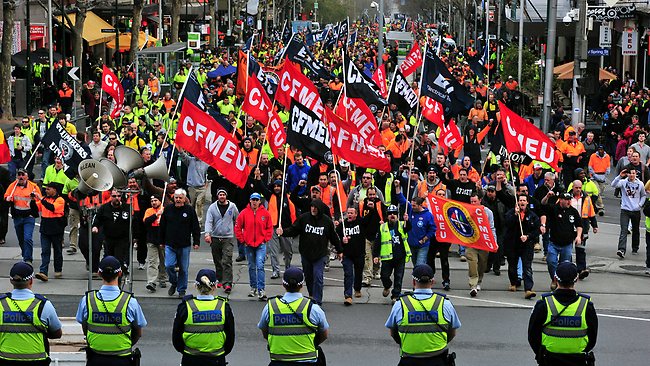
construction-protestIn CFMEU v BHP Coal Pty Ltd [2014] HCA 41, the employee was involved in a protest organised by the CFMEU where he held and waved a sign that said “No principles SCABS no guts”. Some employees of BHP Coal complained about the sign.  The general manager of the Saraji Mine where the employee worked found the word “scab” to be “inappropriate, offensive, humiliating, harassing, intimidating, and flagrantly in violation of BHP Coal’s workplace conduct policy”.  The employee was aware of this policy.  In response, the employee was terminated.

BHP Coal argued that the decision was based on “manner” in which the employee had taken part in the protest, not because he had decided to engage in a CFMEU strike.

The primary judge disagreed, holding that because the adverse action was based on the sign which the employee held and waved, this activity must be taken as one of the reasons for the action.   The High Court of Australia, by a three to two majority, found the primary judge was incorrect, and had “wrongly added a further requirement to s 361, namely that the employer dissociate its adverse action completely from any industrial activity”.

A similar issue was heard in CFMEU v Endeavour Coal Pty Ltd [2015] FCAFC 76, where the employee had been employed on the weekend roster for over five years.  In this time period, he had taken 15 absences, amounting to nearly 30 days.  The employee was moved away from the weekend roster, which had suited the employee and been of financial benefit to him.  Endeavour Coal conceded that this action was taken ‘because’ of the absences, but argued that this decision was purely motivated by operational reasons – as absences on the weekend shifts were much harder to rectify.  The argument was that the adverse action was ‘because’ of the exercise of the workplace right, but not ‘because it was a workplace right.  The majority of the court agreed, Bromberg J stating that a distinction could be drawn between the employee’s absences, and the ‘character’ of those absences.

The current authorities therefore suggest that the adverse action required to ground a breach needs to be ‘because’ of the protected activity, and not merely that the adverse action was taken ‘because’ of some instance of the protected activity arising.  Many people in the legal community consider that the Federal Court have gone too far in this decision.  However, the High Court did not give the CFMEU leave to appeal.

Those of us that are looking for clarity around the word ‘because’ will therefore have to wait for the next chapter to unfold.

July 1

Unfair Dismissal or General Protection? A high pressure choice facing employee litigants

When National system employees are unlawfully dismissed from employment they will generally have a choice of which section under the Fair Work Act to make their application.  Was it an Unfair Dismissal, or was it a contravention of a General Protection involving dismissal?  There is considerable overlap in these actions, but the Fair Work Act insists that only one may be chosen, the choice must be made within 21 days, and the choice is final.   In employment law practice, coming upon a case where an inappropriate choice has been made is a weekly occurrence.  If settled at conciliation this mistake has no consequences, however if the matter proceeds, often this error can be the difference between success and failure.

At first glance the actions seem similar.  A dismissal is ‘unfair’ if the Commission hold it to be ‘harsh, unjust or unreasonable’.  A General Protection, on the other hand, is contravened if an employer takes any type of adverse action against an employee on unlawful grounds, which includes because of the employee the exercising, or proposing to exercise, a workplace right.

But despite the fact that the contextual factors giving rise to these actions are similar, the causes of actions themselves are radically different.

Unfair Dismissal is constrained by strict jurisdictional parameters – parliament very clearly intended this provision to be only open to a specific class of employees.  It is not available to people earning over $138,900 per annum, to people that have been employed less than six months (or one year in the case of small business employers), the person must be ‘dismissed’ in accordance with a specific statutory definition, it is not available in the case of a ‘genuine redundancy’, and it is not available to casual employees unless they have been engaged on a ‘regular and systematic basis’. These parameters are strictly enforced at the Commission.  In legal terms, they have no jurisdiction to do otherwise.

But once the jurisdictional hurdles are overcome, the Commission have a broad discretion to assess the dismissal holistically, and it is only required that the dismissal be ‘harsh’, ‘unjust’, OR ‘unreasonable’. In the often quoted words of High Court Justices Gummow and McHugh “a termination may be harsh but not unjust or unreasonable, unjust but not harsh or unreasonable, or unreasonable but not harsh or unjust.”   These concepts pre-date the Fair Work Act, and at common law it is well understood that an ‘unjust’ dismissal is one in which the employer lacked a valid reason, or in which the employee was not guilty of the misconduct alleged.  An ‘unreasonable’ dismissal is one in which the employer acted unreasonably in coming to the decision to dismiss, or the employee was not afforded adequate procedural fairness.  A ‘harsh’ dismissal is one in which the decision to terminate the employment, within all of the circumstances, is disproportionate to the gravity of the misconduct.   This common law meaning is neatly codified by s 387 of the Act.  Generally, a case will get over the line if the Commission finds any significant fault of this type.

These jurisdictional hurdles are absent for a General Protection application, however in contrast to Unfair Dismissal each of the elements must be proved. If adverse action is alleged in response to the exercise of a workplace right, the employee must clearly identify the workplace right, and demonstrate that they exercised, or proposed to exercise that right.  If this is done, the onus then falls on the employer to prove that the exercise of workplace right was not one of the reasons for the adverse action.  Significantly, however, the reverse onus in itself does not make the employee’s case.  If the employer can prove that the exercise of a workplace right was not a factor in the mind of the decision maker, as a question of subjective fact, then the case will fail.

Many cases would satisfy both, and many would satisfy neither.  In my experience the choice to go with a General Protections application is made either because of the jurisdictional limitations of Unfair Dismissal, or because of the limited scope of compensation available in an Unfair Dismissal application (capped at 26 weeks).  For these reasons, but in particular the high income threshold, General Protections have become the default stomping ground for disgruntled executives.  But in the chase for a larger compensation, many litigants don’t realise that their case may become harder to prove.

FWCOn the other hand, lower paid workers, especially those without representation, often rush to file an unfair dismissal application within the 21-day time limit without ever knowing or getting legal advice that the General Protection provisions may be more appropriate for their case.

In James Morphett v Pearcedale Egg Farm [2016] FWC 1940, the employee was dismissed for aggressive behaviour and offensive language during a workplace meeting.  The employee brought an unfair Dismissal application.  The employee had been angry because he had injured himself at work, and had been threatened with termination because the employer had not wanted the injury to go through work cover.  During the meeting he lost his temper and threatened the employer, resulting in his dismissal.  The Commission held that while the employee’s anger was ‘understandable’ the conduct was not, and ruled that the dismissal was not unfair.  But from the limited facts available, it is very clear that the earlier threat to dismiss was in response to a proposal to exercise a workplace right.  This breach would not have been cured by the employee later losing his temper and being dismissed.  Had he brought a General Protection application, he would have had a much greater chance of success.

CFMEU v Anglo Coal (Dawson Services) Pty Ltd [2015] FCAFC 157, is an example of the exact opposite.   The employee had applied for two days’ annual leave which was refused, and then threatened the employer that he would take sick leave instead.  Coincidentally, on the date in question the employee was genuinely sick.  The employee was sacked, due to the employer’s genuine mistaken belief that the employee was being dishonest in taking the leave.  The employee brought a General Protections application but failed, due to the fact that because the mistake of the employer was genuine, it could not be shown that they made the decision to dismiss him for the prohibited reason.  In spite of the onus, the employer was able to prove that there was no causal connection between the exercise of a workplace right and the decision to take adverse action.   The federal court noted the injustice, but specifically mentioned that an unfair dismissal action had been available to the applicant. Had the action  been brought this way a remedy would have resulted.  It was the applicant’s litigation strategy which had denied him relief.

In summary, an unfair outcome, irrespective of the reason, is almost always best dealt with in the Unfair Dismissal jurisdiction. However, unfair or unlawful intentions on the part of an employer often will be punished more thoroughly under the General Protections provisions. But each case will depend on its own facts. These two recent cases illustrate the dangers of making this assessment incorrectly.  Given the difficulties in this area, and the trouble many employees face in accessing expert legal advice, these won’t be the last.