August 26

Mondelez Update

In our November 2019 blog, we outlined the Full Court of the Federal Court of Australia’s decision on what amounted to a ‘day’ for paid personal/carer’s leave under section 96(1) of the Fair Work Act 2009 (Cth) (the FW Act).

The Federal Court of Australia Decision

The case concerned two employees who worked their contracted 36 hours per week over three 12-hour days. Other employees worked their 36 hours over five days, working 7.2 hours per day. Under the Mondelez Australia Pty Ltd, Claremont Operations (Confectioners & Stores) Enterprise Bargaining Agreement 2017 (the Enterprise Agreement), employees who worked 12-hour shifts were allowed 96 hours per year of paid personal/carer’s leave. This was compared to employees who worked 7.2-hour days and were allowed 80 hours per year of paid personal/carer’s leave.

Continue reading
March 12

Toot Toot, Chugga Chugga, Big Fat Lie

Being a working parent, whether it is full-time, part-time or as a casual, can be hard. There is the juggling act between an employee’s duties to their employer and wanting to give their children every opportunity and experience before they are too old to not like them anymore. In the workplace there are still some negative perceptions around working parents, whether they are actual or imagined. For example, working parents can feel guilty for requesting a day of annual leave to take their child to a children’s concert, such as the Wiggles or Justine Clarke. Some parents take the risk of having a ‘sickie’ to alleviate this guilt. However, working parents who do this risk their jobs. The case of Sean Mamo v Robjan Pty Ltd t/a Yarrawonga Toyota [2019] FWC 7900 is an example of a working father who took this risk and lost.

Sean Mamo v Robjan Pty Ltd t/a Yarrawonga Toyota [2019] FWC 7900

Mr Mamo, a father of a young son, had his claim for unfair dismissal rejected by the Fair Work Commission (the FWC). Mr Mamo claimed a day of personal/carer’s leave informing his employer that his son was unwell. However, Mr Mamo’s son was in fact not sick. The reason for the leave was so Mr Mamo could take his son to a Wiggles concert. Mr Mamo believed any request for annual leave would be rejected. A photograph of Mr Mamo and his son at the Wiggles concert was posted to social media and shown to Mr Mamo’s employer. When asked about his leave Mr Mamo first denied that he had taken his son to a Wiggles concert. However, when shown the photo Mr Mamo admitted to falsely claiming personal/carer’s leave.

Deputy President Colman held that Mr Mamo had not been unfairly dismissed. It was not an unfair dismissal because his employer had a valid reason for dismissal. Falsely claiming personal/carer’s leave amounts to misconduct because it is a breach of an employee’s duty of good faith, it obtains a financial advantage by deception and claims a legitimate right to be absent from work when there is none based on the facts. Mr Mamo deliberately misleading his employer was of sufficient gravity to warrant his dismissal.

What are the legitimate reasons for taking paid personal/carer’s leave and what is an employee’s duty of good faith?

Personal/Carer’s Leave

Paid personal/carer’s leave is one of the 10 National Employment Standards in the Fair Work Act 2009 (Cth) (the FW Act). An employee is entitled to 10 days of paid personal/carer’s leave per year. Any unused paid personal/carer’s leave is accrued from year to year. Section 97 of the FW Act outlines that an employee is only able to take paid personal/carer’s leave if:

  • they themselves are sick or injured; or
  • to provide support or care for a member of the employee’s immediate family or household because that member is sick, injured or if there is an emergency.

Under section 107 of the FW Act an employer can request from the employee proof of the reason for the leave. This is usually in the form of a medical certificate but can also be provided in a statutory declaration.

In Mondelez v Automotive, Food, Metals, Engineering, Printing and Kindred Industries Union known as the Australian Manufacturing Workers Union (AMWU) [2019] FCAFC 138 the Federal Court outlined the principles for paid personal/carer’s leave. Particular to this situation the Federal Court stated that a day taken for paid personal/carer’s leave is an authorised absence from work if, and this is the key, only if an employee is sick or injured or a member of their family or household is sick, injured or involved in an emergency. An employee is unable to take paid personal/carer’s leave for any other reason, such as attending a Wiggles concert.

Duty of Good Faith

Though not expressly written in an employment contract there are certain duties employers and employees owe to each other that are implied by law into the employment contract. One of these duties is the duty of good faith. For employees the duty of good faith requires an employee to act faithfully in the performance of their duties and to act for the benefit of their employer. Employees are also not to act in a way that would or would likely damage the trust and confidence between the employer and employee. Dishonestly taking paid personal/carer’s leave is not acting faithfully and would damage the trust and confidence that an employer has with their employee if the deception is discovered.

Take Home

It is important for employees to understand what paid personal/carer’s leave can and cannot be used for. If employee’s dishonestly use this leave, they risk being terminated for misconduct. Though it might be tempting for an employee to have a ‘sickie’ in order to take their children to a Wiggles concert, or for some other personal reason, they risk their employment. If employers are concerned about any paid personal/carer’s leave taken by employees, they are able to ask for evidence of the reason for taking the leave.

If you are interested in reading more about the interpretation of a day for paid personal/carer’s leave please see my previous blog.

February 18

What are your work entitlements during natural disasters and emergencies?

After a season of devasting bushfires, Australia has now been hit by a tropical cyclone and severe storms causing serious material damages, road closures and flash flooding. These extreme weather events cause devastation and losses affecting individuals and businesses. Many employers are confronted with the impact these natural disasters may have on their workplace and employees. Employers and employees should be aware of their rights and obligations in the midst of a natural disaster.

Modern Awards, enterprise agreements and employment contracts may contain specific provisions in relation to an emergency or natural disaster. So, employers and employees should first check if any particular provision exists. If there is no such entitlement, the Fair Work Act 2009 (Cth) (FW Act) offers a range of available options.

Managing Employees During Natural Disasters

Natural disasters can force employers to temporarily close their business. In such circumstances, section 524 of the FW Act provides that an employer may stand down employees without pay during a period in which:

  • employees cannot usefully be employed because of a stoppage of work; and
  • the employer cannot reasonably be held responsible for the stoppage.

Bushfires or floodings may cause a stoppage of work for which an employer cannot reasonably be held responsible for.  In that case, there is no obligation for employers to pay employees during the period of stand down, but they may choose to do so as a gesture of goodwill. In any event, it is recommended to notify in writing as soon as practicable those employees of the following:

  • the start date of the stand down;
  • whether the employee will be paid or not;
  • the effect on other employment entitlements; and
  • the date when the stand down is expected to end.

When employees are already on leave or authorised to be absent from work, stand down provisions do not apply to them.

Other alternatives should be considered before an employer stands down their employees without pay. The Fair Work Ombudsman advises that alternatives may include:

  • proposing employees to take a period of accrued paid leave, such as annual leave –  this is only possible with the agreement of the employer and the employee;
  • if other worksites exist and have not been affected, considering voluntary work or hours sharing arrangements among sites and employees; or
  • organising flexible arrangements when possible, such as working from home.

Employee’s working arrangements can only be altered in accordance with the FW Act and any relevant award or agreement. Employers should keep in mind the safety and wellbeing of their employees when doing so.

Employees’ Entitlements During Natural Disasters

Natural disasters will often result in employees requiring time off to care for themselves or their family members. There is no specific form of leave available to an employee affected by a natural disaster. Employees who have accrued annual leave may use their annual leave entitlements in these circumstances, with the employer’s agreement. Otherwise, employees may be entitled to personal/carer’s leave or compassionate leave.

Personal/Carer’s Leave

Full-time and part-time employees may have an entitlement to take accrued paid personal/carer’s leave if they are unfit for work because of a personal illness or injury or to provide care or support to a member of their immediate family or household because of a personal illness, injury or in the event of an unexpected emergency. For example, if the school of an employee’s child closes due to a natural disaster, the employee may be eligible for personal/carer’s leave to take care of their child.

Employees who have used all of their paid personal/carer’s leave and casual employees are entitled to two days of unpaid carer’s leave for each particular occasion when a member of their immediate family or household requires care or support due to illness, injury or in the event of an unexpected emergency.

Compassionate Leave

Employees are entitled to two days of compassionate leave for a particular permissible occasion to spend time with a member of their immediate family who has sustained a life-threatening illness or injury or after the death of a member of the employee’s immediate family. Employees, other than casual employees, are entitled to be paid during compassionate leave.

When taking personal/carer’s leave or compassionate leave, employees must give their employers notice of the taking of leave and provide evidence to support the leave period if required.

Community Service Leave for Volunteering

Pursuant to section 109 of the FW Act, employees who are members of a recognised emergency management body may be entitled to take unpaid community service leave for the purpose of engaging in an eligible community service activity, such as dealing with an emergency or a natural disaster, on a voluntary basis.

The FW Act does not specify the amount of time that can be taken. However, the absence of work must be reasonable having regard to the following circumstances:

  • time when the employee engages in the activity;
  • reasonable travelling time associated with the activity; and
  • reasonable rest time immediately following the activity.

During the recent bushfire crisis, the current legislation has been criticised as providing insufficient support to those assisting emergency services as volunteers. The minimum standards in the FW Act can be improved by state law, enterprise agreements or other arrangements implemented by employers in the private sector. It may be unreasonable to expect small businesses to pay their employees when volunteering.  However, larger companies have started to implement more generous volunteer leave arrangements allowing employees to take paid leave when they are away volunteering in emergency services. In response to the crisis, the government has announced a federal scheme to compensate volunteer firefighters. They have also granted an additional four weeks’ paid leave for volunteers firefighters employed in the public sector. However, those announcements have not been enough to stop criticisms in the management of the recent bushfire crisis.

November 8

How long is a day?

The law is an occupation that deals primarily with language.  Words have both an ordinary meaning, and a legal meaning.  Lawyers and parties to litigation will often ask the courts to define the legal meaning of words, when the ordinary meaning is plainly obvious. While this may seem a waste of the court’s time and resources, this can sometimes be critical for the interpretation of legislation, as well as contractual arrangements.

In a blog a couple of years ago, my colleague Brian Powles looked at the legal meaning of the word ‘because’ in relation to Part 3-1 of the Fair Work Act 2009 (Cth).

The Federal Court of Australia was again recently asked to define another very ‘ordinary’ word.  What is a ‘day’, in relation to paid personal/carer’s leave under the National Employment Standards (the NES).

Section 96(1) of the Fair Work Act 2009 (Cth) (the FW Act) provides employees with a right to 10 days of paid personal/carer’s leave, with the result of how the court defines a day, affecting the total leave hours certain employees would be entitled to. An employee can take paid personal/carer’s leave if they are sick or injured, or if they need to provide care or support to an immediate family member, or a member of their household who is sick, injured, or has an emergency.

Case

The case was Mondelez v Automotive, Food, Metals, Engineering, Printing and Kindred Industries Union known as the Australian Manufacturing Workers Union (AMWU) [2019] FCAFC 138. Mondelez’s employees work 36 hours per week. Some employees work their 36 hours over five days, working 7.2 hours a day. Other employees complete their 36 hours in three days, working 12 hours per day. Under the Mondelez Australia Pty Ltd, Claremont Operations (Confectioners & Stores) Enterprise Bargaining Agreement 2017 (the Enterprise Agreement) employees who worked 12 hour shifts were allowed 96 hours per year in paid personal carer’s leave. Employees who worked 7.2 hour days were allowed 80 hours per year. Mondelez sought two declarations from the Federal Court of Australia:

  1. When a 12 hour shift employee takes paid personal/carer’s leave they are to be deducted 12 hours from their accrued hours of paid personal/carer’s leave; and
  2. Mondelez employees’ entitlement to paid personal/carer’s leave was more beneficial under the Enterprise Agreement compared to the ‘10 days’ under the NES.

The majority judgment of Justices Bromberg and Rangiah held that the declarations sought by Mondelez could not be made.

Submissions were made by Mondelez and the Australian Manufacturing Workers Union (the AMWU) on the definition of a ‘day’ for paid personal/carer’s leave in the NES. Mondelez submitted that a ‘day’ was calculated by dividing an employee’s weekly hours by the number of days in the company’s working week, being five days for Mondelez. Whereas, the AMWU defined a day as an ordinary calendar day, being 24 hours.

The majority judgment did not accept the AMWU’s interpretation of a day meaning 24 hours per day of paid personal/carer’s leave. Justices Bromberg and Rangiah stated that the better interpretation of a day for paid personal/carer’s leave was a ‘working day’, being the portion of the 24 hour period the employee was allocated to work on that day. In forming their decision Justices Bromberg and Rangiah explained that personal/carer’s leave was not an automatic entitlement for employees to take leave. An employee is only able to take personal/carer’s leave for a personal illness or injury, or the illness, injury or emergency of an immediate family member, or member of the employee’s household. Justices Bromberg and Rangiah noted that not all employees would take their full or even part of their personal/carer’s leave entitlement.

Justices Bromberg and Rangiah held that under the Enterprise Agreement’s entitlement to 96 hours paid personal/carer’s leave, which calculated to be eight 12 hour shift days, was less beneficial than the NES entitlement for Mondelez’s employees. They held that under the NES, employees who worked 12 hour shifts would receive 10 days’ worth of 12 hour shifts in paid personal/carer’s leave.

In their judgment Justices Bromberg and Rangiah provided some conclusions about a ‘working day’ and personal/carer’s leave. Paid personal/carer’s leave was an authorised absence from work and a form of income protection for employees so that they are not disadvantaged in the event of a personal illness or injury, or that of an immediate family member or member of their household. It was not an entitlement to take leave except in those circumstances.  A day for personal/carer’s leave was the portion of the normal 24 hour day that an employee was allocated to work. The entitlement to paid personal/carer’s leave accrues over the year of service. When an employee takes paid personal/carer’s leave that day, or the part of the day that they were absent, is taken from their accrued leave. The ability to take such paid leave is limited to how much the employee has accrued.

Take Home

The message from this decision is that when an employer is accounting for paid personal/carer’s leave they are to do so in days or part days, not hours. An employee is entitled to 10 days absence from work due to their own illness or injury, or the illness, injury or an emergency for an immediate family member or member of the employee’s household. Days being whatever portion of that day the employee was expected to work.

However, employers should hold off making any changes to their systems as the Morrison Government and Mondelez have sought leave to appeal the decision in the High Court.

January 24

Growing support for a workplace response to domestic violence

Violence against women is now recognised as a serious and widespread problem in Australia. Whilst awareness has increased of domestic violence as a community issue, there is still much to be done to support victims. 2017 saw an increase in support for a workplace response to family violence, through the inclusion of family and domestic violence leave in all modern awards, or the National Employment Standards. At a minimum, unpaid leave looks likely to be inserted into modern awards in 2018, meanwhile the unions, Greens and Labor Party continue to push for paid leave.

What is domestic violence leave and why is it needed?

Family and domestic violence leave provides victims of violence by a family member time off work to attend legal proceedings, counselling, and medical appointments, as well as relocating or making other safety arrangements. Paid family and domestic violence leave can ensure financial security and support victims escaping abusive relationships.

Some large private sector employees, such as Telstra, KPMG, Woolworths, IKEA, NAB, Westpac and PwC, currently provide paid family and domestic violence leave entitlements. In addition, most State governments have domestic violence protections for their public servants, some of which include paid leave. However, the majority of Australian employees are reliant on a modern award for their minimum entitlements, and the unions are pushing to standardise workplace support.

ACTU’s application for paid domestic violence leave

In July 2017, a bid by the Australian Council of Trade Unions (ACTU) to have 10 days paid leave available to Australia’s two million award dependent employees, was rejected by the Fair Work Commission.

The Commission acknowledged that domestic violence is a significant problem in society, in the workplace, and for the national economy. It noted the inability of existing workplace entitlements to meet the needs of employees who experience domestic violence as their need for leave is often urgent and they may not able to request annual leave or flexible work arrangements at short notice. However, the Commission was not satisfied that ten days paid domestic violence leave was necessary to meet the objectives of the modern award and concluded that a cautious approach should be taken to the introduction of domestic violence leave, citing concerns over increased employer’s costs and the lack of data or evidence regarding the operation of such leave.

However, the Commission formed the preliminary view that an unpaid leave entitlement should be included in modern awards to enable victims to deal with the consequences of the violence. The Commission is currently reviewing submissions on the drafting of such a provision, such as what quantum of unpaid leave is appropriate, who can access it, and notice and evidence requirements.

Introduction of the Greens bill

In late November 2017, The Greens released draft legislation to introduce 10 days’ paid family and domestic violence leave as a new entitlement in the National Employment Standards (NES). The Australian Labor Party had previously committed to five days paid leave in the NES, but in response to the Greens bill, in early December, they raised their commitment to ten days.

Resistance to the introduction of paid domestic violence leave

The Coalition and some employer representatives have resisted the extension of paid family violence leave to all employees in Australia, through inclusion in modern awards or the NES. Their primary concern is that paid domestic violence leave would impose a significant and undue expense on employers, with the Australian Chamber of Commerce and Industry (ACCI) claiming it could cost employers as much as $205m to create just one day of domestic violence leave per worker per year.

A common objection from employer groups is that domestic violence is a societal issue, not a problem that is created by employers, and as such, a government funded national system of domestic violence leave is required, in the same manner as paid parental leave. Other opponents of the proposal argue domestic violence leave is just another union shakedown, and any paid family violence leave provisions will be abused to justify non-necessary work absences, i.e. it will become the new “sickie”.

There is also a concern that the current proposals might drive a further divide between the entitlements of permanent and casual employees. The paid family violence leave provisions currently available in some enterprise agreements generally only cover employees in full time or part time employment, when casual employees facing violence do not even have access to paid annual or sick leave entitlements. The ACTU submits that 51% of award-covered women are employed as casuals, so it is essential that casuals are included in any amendments. Otherwise, paid family violence leave will only serve to further incentivise employers toward casualisation of the workforce.

There is also recent research which challenges the effectiveness of paid domestic leave policies, with the conversion from policy into practice falling short. A survey of HR professionals published by the Australian HR Institute in September 2017 concluded that Australian workplace domestic violence policies don’t translate into practice. Only 14% of respondents currently report any form of specific training for supervisors and managers to help victims disclose domestic violence, and only 18% have any form of manager training to recognise victims of domestic violence.

Arguments in response

Research by the Centre for Future Work at the Australia Institute suggests that the costs of paid domestic violence leave is unlikely to impose a noticeable increase in labour costs for employers, and any costs are likely to be largely offset by benefits such as reduced turnover and improved productivity. Only about 1.5% of female employees and around 0.3% of male employees are likely to utilise paid domestic leave provisions, costing $80m to $120m per year. The massive discrepancy in cost compared the ACCI’s modelling, derives from utilisation assumptions, with the ACCI’s figures based on 25% of female and 10% of male workers accessing the leave each year. The ACCI utilisation rate is far greater than what has been experienced by employers who already have paid domestic leave provisions in place.

Supporters of paid family violence leave argue that there would be two tests to ensure the system is not open to abuse, and would restrict the incidence of leave-taking to subset of those workers who actually experience domestic violence. Firstly, the leave must be related to specific activities or events related to the violence, to support employees in their efforts to escape the violence. It’s not intended as compensatory leave for victims. Secondly, documentary evidence must be provided regarding the nature and timing of those events if requested, such as a note issued by police, a doctor, or a lawyer, for example.

With regards to casuals, the unions bid for paid leave to be included in the modern awards, and the Greens’ bill regarding the NES, both provide for paid leave entitlements to be extended to casual employees. Under the ALP’s proposal, casual workers would be entitled to unpaid leave.
Conclusion

The argument that paid family and domestic violence leave is too expensive has been refuted by the research which considers the actual experience of several Australian employers who have already implemented paid leave policies. It shows that in practice, paid leave entitlements are not frequently utilised, and any incremental costs are offset by the broader economic benefits.

The complexity of family violence requires a strategic approach by all levels of government, business, and the community. Developing a workplace response to domestic violence also requires support measures besides paid leave, such as training for managers to help victims disclose domestic violence, referral of employees to appropriate domestic violence support services, flexible work arrangements; and no adverse action or discrimination of the victims of domestic violence. Unless workplaces take measures to promote disclosure, and managers are trained to support their employees, the stigma already involved in revealing domestic violence is unlikely to dissipate, and the purported benefits and costs of providing paid family and domestic violence leave are unlikely to be realised in any event.


October 25

Another Chapter to the Paid Parental Leave Saga

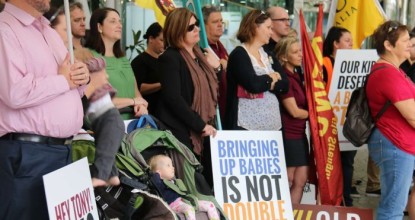
In another chapter to the saga which is the Coalition’s position on parental leave, yesterday, Social Services Minister Christian Porter announced that he wanted amendments to the Federal Government’s Paid Parental Leave scheme to pass through the Senate and come into effect by 1 January 2017, just ten weeks away.

The amendments would see parents who receive payments from their employers for having a child be prevented from accessing the Federal Government’s Paid Parental Leave Scheme, which provides for up to 18 weeks of payments at the national minimum wage of $672.70 per week, or a total of $12,108.60.

Whilst there is no obligation to do so, some employers currently provide their employees with payments for parental leave on top of the government’s scheme. Businesses do this for a variety of reasons, including wanting to assist employees and their families through a difficult and undeniably expensive period of time, wanting to encourage parents to spend time with their new baby rather than rush back to work due to financial concerns, attempt to reduce the gender pay gap and in a bid to encourage employees to remain loyal to the business.

Under changes to the paid parental leave scheme which the Turnbull Government is hoping to bring in by the passing of the Fairer Paid Parental Leave Bill 2016, employees who receive payments from their employer for parental leave will only be able top up their payment to $12,108 or if they receive more than that from their employer, they will not be able to access the government scheme at all.

As an example, if an employee is provided with payments totalling $10,000 from their employer for parental leave, they will only be able to top up their paid parental leave by a further $2,108 from the government. If an employee receives $15,000 from their employer, they will be excluded from receiving any payments from the government.

This is the third change in the Coalition’s policy in three years. In the lead up to the 2013 federal election, Tony Abbott promised to pay women 26 weeks wages up to a threshold of $150,000 per year plus superannuation on each occasion they had a child. Had this policy been bought in, women would have been eligible to receive up to $75,000 from the government. This policy was later revised due to a budget “emergency”.

In May 2014, Abbott announced a change to the previously promised policy, with plans to provide women with 26 weeks of paid parental leave up to a threshold of $100,000 per year plus superannuation. This had the effect of reducing the total amount eligible to be received to $50,000. This policy was later dumped due to lack of parliamentary and party support.

Then, in one of the largest election backflips in Australian political history, Abbott announced in May 2015that the Coalition had again had a change in policy and that it planned to prevent women from “double dipping”, which they took to mean that parents would not be allowed to access the government scheme if they received parental leave payments from their employers. This complete backflip in policy meant that in a period of less than two years, the Coalition had varied their policy on three occasions, resulting in parents being up to and exceeding $63,000 worse off on the birth of each child than they would have been if the Coalition had stuck with Abbott’s “signature” “fair dinkum” policy that he was so passionate about.

Needlessly to say, the latest policy change was controversial, especially with it being implied that parents were rorting the system by “double dipping”, despite it being repeatedly pointed out that to amount to “double dipping”, parents would be required to be receiving payments from the same source, which was of course, not the case.

When asked about the rush to bring in the changes, Christian Porter said:

“It’s always been the case that the scheme has been designed, and these changes are also designed, to try and ensure that as many mothers are participating in the workforce and are able to re-participate after the birth of a child, having provided for a fair amount of time to bond with the child after birth.”

4066612-3x2-340x227

This completely disregards the fact that the Productivity Commission, in its 2009 report, recommended providing parents with up to six months of parental leave payments because this was the amount of time deemed by the World Health Organisation as necessary for parents to bond with their child after birth and to allow mothers to breastfeed, which has numerous (uncontroversial) advantages for both the mother and child.

It now appears, based on the comments made by Christian Porter, that the government is no longer interested in the social and economic benefits offered by allowing employees time to bond with their child, but that instead, of primary importance, is that women return to work as soon as possible so that they do not continue being unproductive members of society. As one of our contributors, Brian Powles pointed out earlier this year, paid parental leave was never intended as (and is not) a welfare payment. However, it seems that nobody informed Christian Porter of this when he attempted to avoid using the inflammatory phrase, “double dipping” that have been used by his colleagues in the past and still explain the unexplainable reason for the government’s backflip.

If the Bill makes it through the Senate and comes into effect by 1 January 2017, this will impact thousands of women who are currently in their third trimester and have previously planned ahead with their partners to determine how much time they can afford to take off work to spend with their child. This unexpected change could force many parents back to work much earlier than they had previously planned and will undoubtedly cause financial pressure on many families, most of whom are from the lower to middle class.

By international standards, Australia’s paid parental leave is modest. In Sweden, parents are eligible to receive up to 480 days of paid parental leave, 90 of which are reserved solely for fathers and the leave can be used anytime up until the child’s eighth birthday. Even in Mexico, a country which is hardly renowned for its progressive social policies, mothers receive 12 weeks paid parental leave, which is paid at 100% of earnings.

The fact that Australia is offering parental leave at the national minimum wage and not at actual earnings, together with the fact that employees are capped at receiving $12,000, from the government, places Australia far behind much more progressive Scandinavian and European countries and on par with countries such as Brazil, Costa Rica and even Cuba.

So, what does this mean for employers who have, up until now, generously provided employees with parental leave payments on top of the government’s scheme? There can be no doubt that if the Bill passes through the Senate, that employers will be dis-incentivised to provide payments to their employees if this will reduce (or eliminate altogether) the employee’s entitlement to access the government scheme. After all, why should a business fork out money to pay an employee when ultimately, the employee will not get any added benefit for it?

This will lead to employers coming up with creative ways to provide payments to their employees for time they take off to have a child, whether that be a carefully timed ‘bonus’ payment before the leave commences, a return to work incentive bonus or non-monetary gifts such as gift vouchers or supplies for when the baby is born.

Whatever imaginative ways that businesses come up with to work around the government’s ‘loophole’, it can be almost guaranteed that the Coalition will not be saving the $1.2 billion it alleges will be saved by the changes if it can get Senate crossbenchers to support the Bill.