February 18

What are your work entitlements during natural disasters and emergencies?

After a season of devasting bushfires, Australia has now been hit by a tropical cyclone and severe storms causing serious material damages, road closures and flash flooding. These extreme weather events cause devastation and losses affecting individuals and businesses. Many employers are confronted with the impact these natural disasters may have on their workplace and employees. Employers and employees should be aware of their rights and obligations in the midst of a natural disaster.

Modern Awards, enterprise agreements and employment contracts may contain specific provisions in relation to an emergency or natural disaster. So, employers and employees should first check if any particular provision exists. If there is no such entitlement, the Fair Work Act 2009 (Cth) (FW Act) offers a range of available options.

Managing Employees During Natural Disasters

Natural disasters can force employers to temporarily close their business. In such circumstances, section 524 of the FW Act provides that an employer may stand down employees without pay during a period in which:

  • employees cannot usefully be employed because of a stoppage of work; and
  • the employer cannot reasonably be held responsible for the stoppage.

Bushfires or floodings may cause a stoppage of work for which an employer cannot reasonably be held responsible for.  In that case, there is no obligation for employers to pay employees during the period of stand down, but they may choose to do so as a gesture of goodwill. In any event, it is recommended to notify in writing as soon as practicable those employees of the following:

  • the start date of the stand down;
  • whether the employee will be paid or not;
  • the effect on other employment entitlements; and
  • the date when the stand down is expected to end.

When employees are already on leave or authorised to be absent from work, stand down provisions do not apply to them.

Other alternatives should be considered before an employer stands down their employees without pay. The Fair Work Ombudsman advises that alternatives may include:

  • proposing employees to take a period of accrued paid leave, such as annual leave –  this is only possible with the agreement of the employer and the employee;
  • if other worksites exist and have not been affected, considering voluntary work or hours sharing arrangements among sites and employees; or
  • organising flexible arrangements when possible, such as working from home.

Employee’s working arrangements can only be altered in accordance with the FW Act and any relevant award or agreement. Employers should keep in mind the safety and wellbeing of their employees when doing so.

Employees’ Entitlements During Natural Disasters

Natural disasters will often result in employees requiring time off to care for themselves or their family members. There is no specific form of leave available to an employee affected by a natural disaster. Employees who have accrued annual leave may use their annual leave entitlements in these circumstances, with the employer’s agreement. Otherwise, employees may be entitled to personal/carer’s leave or compassionate leave.

Personal/Carer’s Leave

Full-time and part-time employees may have an entitlement to take accrued paid personal/carer’s leave if they are unfit for work because of a personal illness or injury or to provide care or support to a member of their immediate family or household because of a personal illness, injury or in the event of an unexpected emergency. For example, if the school of an employee’s child closes due to a natural disaster, the employee may be eligible for personal/carer’s leave to take care of their child.

Employees who have used all of their paid personal/carer’s leave and casual employees are entitled to two days of unpaid carer’s leave for each particular occasion when a member of their immediate family or household requires care or support due to illness, injury or in the event of an unexpected emergency.

Compassionate Leave

Employees are entitled to two days of compassionate leave for a particular permissible occasion to spend time with a member of their immediate family who has sustained a life-threatening illness or injury or after the death of a member of the employee’s immediate family. Employees, other than casual employees, are entitled to be paid during compassionate leave.

When taking personal/carer’s leave or compassionate leave, employees must give their employers notice of the taking of leave and provide evidence to support the leave period if required.

Community Service Leave for Volunteering

Pursuant to section 109 of the FW Act, employees who are members of a recognised emergency management body may be entitled to take unpaid community service leave for the purpose of engaging in an eligible community service activity, such as dealing with an emergency or a natural disaster, on a voluntary basis.

The FW Act does not specify the amount of time that can be taken. However, the absence of work must be reasonable having regard to the following circumstances:

  • time when the employee engages in the activity;
  • reasonable travelling time associated with the activity; and
  • reasonable rest time immediately following the activity.

During the recent bushfire crisis, the current legislation has been criticised as providing insufficient support to those assisting emergency services as volunteers. The minimum standards in the FW Act can be improved by state law, enterprise agreements or other arrangements implemented by employers in the private sector. It may be unreasonable to expect small businesses to pay their employees when volunteering.  However, larger companies have started to implement more generous volunteer leave arrangements allowing employees to take paid leave when they are away volunteering in emergency services. In response to the crisis, the government has announced a federal scheme to compensate volunteer firefighters. They have also granted an additional four weeks’ paid leave for volunteers firefighters employed in the public sector. However, those announcements have not been enough to stop criticisms in the management of the recent bushfire crisis.


June 6

Travelling: it’s all in a day’s work – 3 issues employers must consider for employees who travel

Domestic and overseas travel has become highly accessible and affordable which has presented many opportunities for national and multinational businesses as employees can travel relatively easily and cheaply between offices, sites and clients. In fact, the prevalence of business travel is quite significant and in 2016, the Australian Bureau of Statistics reported 9% of overseas trips taken by Australian residents were related to business. This is quite a substantial figure and although long distance travel clearly offers many benefits for employers, it also raises questions as to their legal obligations and how to best manage employees who are away from the office and required to travel for work.

Businesses must consider three issues to ensure that their travelling employees are behaving and performing appropriately whilst also ensuring protection of the business’s commercial interests and adherence to legal obligations.

1. Manage employee behaviour and performance

Everyone would be aware of the saying: “when the cat’s away, the mice will play”. This saying is never more relevant than when employees are away travelling for work purposes, often away from their managers with little to no contact with them or others in the workplace. Whilst most employees who are travelling interstate or overseas would be sensible and senior enough to understand their obligations to behave appropriately and perform to their usual high standards, being away from their normal workplace and supervision can sometimes cause employees to lower their guard and relax their standards.

In Mitchell-Innes v Willis Australia Group Services Pty Ltd (No 2) [2014] NSWDC 250, a NSW General Manager was required to travel interstate to attend a training conference. The night before the conference, a group of staff went out for dinner and later went to a nearby pub, where a substantial amount of alcohol was consumed well into the following morning. The manager attended the training conference the next day where his colleagues claimed he smelt strongly of alcohol, was relaxed, playful, smiling, laughing, enjoying himself, talking loudly, slurring his words, making animal noises and throwing lollies. The business claimed the manager was intoxicated and his employment was terminated for gross misconduct. The Court found that his behaviour did not amount to misconduct, having regard to the fact the incident was a one-off and the workplace had a culture of consuming alcohol whilst wining and dining clients. The manager was initially awarded damages of almost $300,000, which was later reduced to $90,000 on appeal.

This case demonstrates the requirement for businesses to clearly articulate the standards expected of employees whilst they are travelling and that they can and will be held accountable for their actions if they misbehave whilst they are away. It also raises issues with businesses encouraging and supplying alcohol to employees, which often increases with business travel. If staff are likely to be drinking whilst they are working, businesses should consider implementing clear policies and expectations about the amount permitted to be consumed and the behaviour that is expected of them.

2. Protect confidential information

In today’s technological age, it is difficult to imagine an employee who is required to travel for work not using a portable device whilst they are travelling, whether that be a laptop, mobile phone or tablet. Whilst this offers obvious benefits for both the employee and the business, it also raises issues of how confidential information is protected, not only from misuse by hackers or unsecured networks, but also from employee’s who have unfettered and unsupervised access to the business’s confidential information.

Employees should be required to only use devices provided by the business for work purposes and not to use them for personal purposes whatsoever. Similarly, employees should not be permitted to use personal devices for work purposes under any circumstances as it is almost impossible to recover all confidential information upon an employee’s termination or to determine where that confidential information might have been sent.

13572055 - portrait of caucasian hacker with balaclava

In APT Technology Pty Ltd v Aladesaye [2014] FCA 966 and APT Technology Pty Ltd v Aladesaye (No 2) [2016] FCA 203, an employee was employed by APT and worked remotely from his residential address. After suspicion of involvement with a rival company, APT retrieved the laptop and mobile phone they had issued to the employee and discovered he was servicing APT clients through a business he operated while still employed by APT. The employee had accessed and saved confidential files belonging to APT on his private computer, which were retained and used to benefit his new business. APT were successful in restraining the employee from dealing with or soliciting its clients and from disclosing APT’s confidential information.

This case demonstrates the importance of ensuring the separation of work owned and issued devices and personal devices owned by employees. Businesses must have clear workplace policies and programs which prevent employees from accessing or saving company documents on private devices, particularly when staff are working remotely away from the office with little supervision.

3. Ensure employees health and safety

Most employers understand they have a duty of care to provide a safe working environment for their employees when they are working in a normal workplace, however, under work health and safety legislation, there is no differentiation made between an Australian workplace or an overseas place where an employee is working, whether that be a client’s office, an airport or their hotel room. This means that even when employees are travelling overseas, employers are required to eliminate or minimise risks so far as reasonably practicable. When employees are travelling for work, a business may be required to (in addition to the usual precautions that businesses must take):

  • Assist employees to obtain necessary travel vaccines
  • Monitor official travel warnings and providing advice to the employee
  • Implement an emergency response policy, especially if the employee is travelling to a potentially dangerous area
  • Create individual business travel plans so employees have support if something goes wrong
  • Ensure that staff have travel insurance

In Workers Compensation Nominal Insurer v ODonohue [2014] NSWWCCPD 1, a professional actor who was engaged under a NSW contract, ruptured his Achilles tendon whilst performing in Bahrain. As the employment was adequately connected to NSW, the actor was entitled to compensation. However, in another case, Qantas Airways Limited v Watson (No 3) [2010] NSWWCCPD 86, a pilot on a compulsory break from flying was not entitled to compensation for an injury sustained in a car accident when returning to his hotel after visiting friends, as he had not been encouraged or induced to be on a road at the time of the accident by his employer.

As these cases demonstrate, an employer will not be liable for any and all injuries an employee may suffer whilst overseas or out of the office. The injury or illness must have occurred in the course of or arising out of their employment.

As the globe becomes more interconnected with continuous improvements in technology being made, it is likely that many businesses will face challenges with having a mobile workforce that are travelling between different offices, clients and countries. Being prepared and understanding the business’ obligations, will assist the business to protect its commercial interests whilst also ensuring that employees represent the business to a high standard.

August 2

Workplace Benefits and Perks vs Salary – A Balancing Exercise

We are seeing an increasing number of companies that are offering extensive, lucrative and sometimes unusual workplace benefits to employees in an effort to not only attract, but also retain a talented workforce. The best example of employers turning to (sometimes outrageous) workplace benefits is never more apparent than among the innovative technology giants of Silicon Valley, where talented and creative employees are hard to find and even harder to keep from leaving to work for competitors.

Google, arguably one of the most desirable employers in the world, maintains doctors, chiropractors, massage therapists and physical therapists on campus for employees. Facebook, also an employer reliant on attracting creative and talented employees, offers reimbursement for day care and adoption fees, as well as a maximum $4,000 ‘baby cash’ for newborns. Apple and Facebook gained global attention in 2014 for announcing that they would help female employees pay for freezing their eggs. In Australia, we have seen kikki.K, which sells stationery and gifts, offer employees a paid day off work for their birthday and OBS provide an Xbox room for team building, great coffee and (apparently) lots of beer. Atlassian even offers new hires a ‘holiday before you start’ travel voucher for pre-employment rest and relaxation.

Whilst it is easy to see how these large corporations can afford outrageously expensive workplace benefits for their employees, there is also an increasing trend for small to medium size businesses to jump in on the action in an effort to retain talented employees and encourage them to stay for the long term. The message from these businesses is that whilst they obviously have less cash to throw around than the huge tech corporations, they want to ensure employees are happy and assist them to maintain that ever elusive work/life balance. Benefits that I have seen smaller businesses provide to employees include gym memberships, ability to work from home, health insurance, additional annual leave and paid parental leave. Ever conscious of the stresses that work can bring to employees lives, I’ve also seen small businesses offer additional ‘no questions asked’ days off work, where an employee is able to tell work that they won’t be coming in, without the need to provide a reason or medical certification.

Many of these benefits do not largely affect the bottom line of the business and are not all that costly to provide to employees. Whilst these benefits are not intended to replace a portion of an employee’s salary, employees do recognise that their employer is going above and beyond their minimum obligations and from a number of studies that have been conducted, employees highly value these workplace benefits and are looking for these benefits when joining organisations.

This is no more obvious than in Generation X and Millennial employees, who, unlike their Baby Boomer predecessors, are looking to employers to provide financial security, social consciousness and employee wellbeing in addition to competitive salaries. In a study comparing their Millennial candidates to the remainder of their candidate workforce, recruitment firm Hays, found that benefits, in addition to competitive salaries, are a significant influence in Millennial employment decisions. 42% of Millennial respondents said that they would not accept a job that did not provide perks and employees, above anything else, still expect competitive salaries.

However, whilst employees are looking for workplace benefits, the provision of these ‘perks’ is not the most important consideration and generally, the focus only turns to benefits once basic pay and working condition requirements have been met. A PwC survey of Millennials ranked competitive wages and other financial incentives higher in importance than good benefits packages. This shows that workplace benefits, to use the words of the Hays study, are merely viewed as additional ‘perks’.

Whilst the vast majority of businesses are not going to be able to afford to gift employees extravagant workplace benefits, this does not mean that small to medium size employers are out of the race altogether. Smaller businesses who want to provide additional perks to employees must balance what they can realistically afford, the type of employees they want to attract and retain and the salary expectations of those employees. There is no point in a business offering an excellent paid parental leave scheme if the business largely employs older, senior employees who have grown children. Similarly, there is little advantage in offering a gym membership or an additional day off work for birthdays if the business cannot afford to pay competitive salaries to staff as these benefits are probably not going to be enough to prevent staff looking elsewhere to meet their salary expectations.

For those businesses who are unable to consider offering workplace benefits to staff, all is not lost. The PwC survey found that Millennials value personal learning and development more than any other workplace benefit. Whilst providing, regular, detailed feedback to employees can be time consuming for managerial staff, it has very little, if any costs, associated with it. Establishing an organisational culture of feedback and reward will not only assist in retaining staff who wish to continue learning, but will also ensure that the best employees are always improving their performance and therefore, improving the productivity and services offered by the business.

April 30

Following the leader, is a pinch of salt quite enough?

When it comes to business practices and innovation – the loudest opinions, not surprisingly, come from business innovators and successful entrepreneurs.  The ability to think ‘outside the square’ is generally the thing that has made them successful.   When they publicize their ideas, the business community are quick to promote them automatically as the new paradigm – what’s ‘outside the square’ for the innovators becomes the new norm for everybody else.

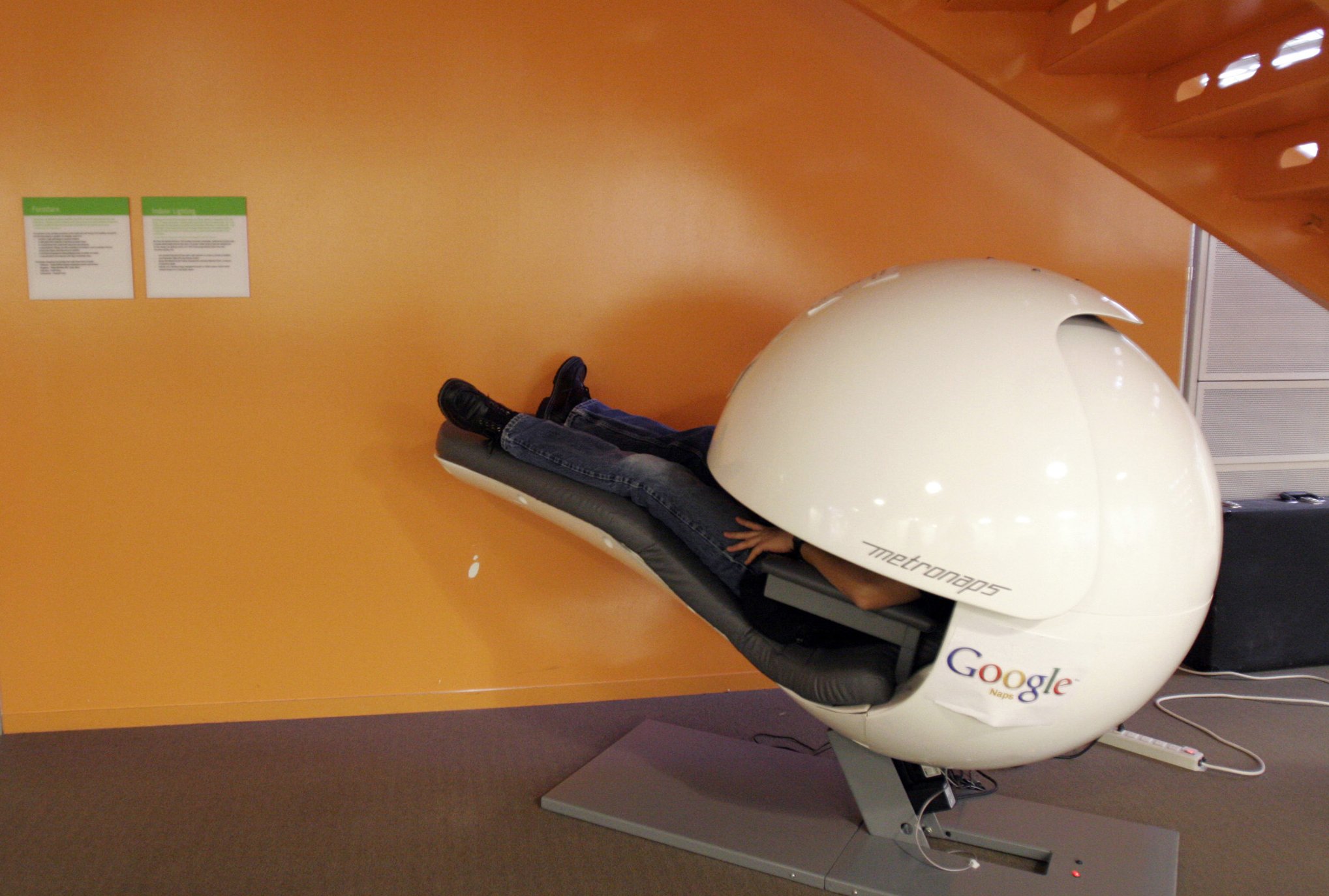
A 'nap pod'in use at Google

A ‘nap pod’in use at Google

Views on how we should employ each other is one of the very hottest topics.  Google, Apple, Facebook are all setting the new industry ‘norms’ for employment.   For Steve Jobs it was about how you hire, for Mark Zuckerburg it’s about how you inspire, for Microsoft it’s hot-desking, for Google it’s about company culture – driven by ‘nap pods’ ‘free food’, rental cars and on-site day-care.   Richard Branson, although frankly lacking in quite the same level of ‘silicon valley cool’, has also  been continually vocal on how the workplace should be, advocating unlimited annual leave, and zero restriction on working from home.

In theory, it’s great to look at these industry giants for innovative practice, but in my opinion a little bit of realism is needed before applying these practices into standard workplaces with an expectation that they will be effective.  The simple fact is that what these companies have in common is that they are hugely  popular to work for:  Facebook and Google each report having over 250,000 job applicants per year.  Forgive me for cynicism, but when you hand-pick your workforce from a pool of a quarter of a million of the world’s most talented and ambitious, is there really much of a challenge keeping these people productive and happy?  These companies could probably introduce the ‘upside down, electricity free office with hologramatic furniture’ and still get the results they require.    These trendy management  innovations fail to acknowledge that in the industries most of us operate within (let’s call it “the real world”), a lot of the workforce would rather not come to work if they didn’t have to, and almost all of us would be a little happier doing slightly less each day than is currently expected of us while we are here.   There’s nothing shameful in admitting this,  it is after all why we get paid.  Managing these staff scenarios is the real paradigm, and most of the time the solutions are very firmly ‘inside the square’.

google

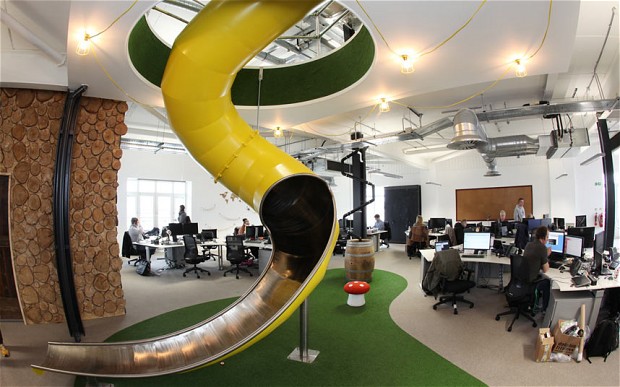
The open plan google office

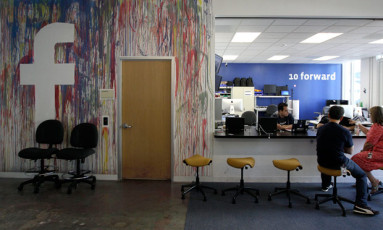
In fact the office layout innovations have already been thoroughly discredited now in terms of productivity and staff happiness. The Washington Post had this to say about the open plan, while the Sydney Morning Herald had this on ‘hot desking.’  It doesn’t take a Steve Jobs or Mark Zuckerberg sized intellect to see that the saving in real estate cost is the real driving force behind these measures.  But it also comes down to the nature of the work done.  Not every workplace is seeking large amounts of innovation or extroverted collaboration.  In my firm,  I am not really looking for my legal staff to ‘innovate’, shout their ideas across the office, or graffiti the walls with inspirational statements.   I would prefer them to ‘concentrate’ on the tasks they are assigned, which is not best achieved cramped onto a shared worktop while someone plays ping-pong 50cm from their head.  There’s also the very real danger that far from encouraging collaboration and equality, these systems result in the type of school-yard ‘survival of the fittest’ which is a breeding ground for a variety of workplace problems.   This Chloe Taylor article gives a great example of what can go wrong.

Hot desking

Pic via HC Magazine

But with the more trivial benefits, ask any hospitality operator how an unlimited ‘free food’ policy would work for them, or retail operator whether they would consider installing a ‘nap pod’ for the use of sales assistants in each of their stores.  In the “real world”, where the benefits and remuneration available to employees is generally far below their expectations or desires, these types of luxuries are ridiculous.  It’s almost insulting to talk about them seriously.

bransonBut Branson’s concepts are a little more disingenuous.  In talking about his ‘smart’ and ‘simple’ solution, he’s never gone on record to explain why his annual leave scheme only applies to his ‘personal staff’ – (his executive team of 170).  I’m fairly certain that Sir Richard is aware that if he gave his Virgin Airlines Baggage handlers (for example) unlimited annual leave without keeping track of it, or invited them to work from home any time they liked, there would be significant impacts on productivity.   In fact he knows that it’s only among the highly competitive and ambitious of his team that a self-managed annual leave scheme will keep annual leave at acceptable levels, it may even reduce.   In competitive executive circles, there has always been a ‘badge of honour’ in refusing to take personal leave.  By analogy, there is very real chance that this could happen with annual leave under Branson’s model.   Currently executives normally struggle to use the leave they are entitled to.  Many exit jobs after a decade and are paid out accruals of up to 400-500 hours.  How is Branson intending to calculate these payments on termination?  That’s right, nobody keeps track anymore.  How convenient?

Looking to the innovators for ideas in the abstract is always a great idea.  But a hefty pinch of salt is needed before putting it into practice at work.