October 30

What to make of the “Change The Rules” campaign
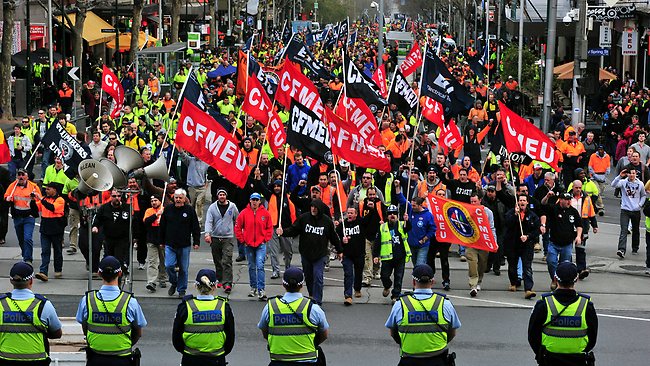
Last Tuesday, October 23, 2018, union rallies were held in Melbourne and Sydney in support of the Australian Council of Trade Union’s (‘ACTU’) “change the rules” campaign. The protests followed a series of national TV and radio advertisements launched in early October. The “change the rules” campaign is seeking to “re-balance the system and negotiate on more equal terms with big business.” Despite the ACTU’s active involvement in the introduction of the Fair Work Act 2009 (Cth) (‘Fair Work Act’), the ACTU is now pushing for another overhaul of the industrial relations landscape. In the noise created by this campaign, the unions have perhaps overlooked the fact that for a large class of employees, the current framework provides better protection and job security than they have ever had.

The majority of workplaces in Australia are now governed by the Fair Work Act. The Fair Work Act was introduced by the Rudd Government after coming into power in 2007, largely due to a successful election campaign promising to reform the Howard government’s Workplace Relations Amendment (Work Choices) Act 2005 (Cth) (‘WorkChoices’).

WorkChoices was heavily criticised for increasing employer protections and flexibility for businesses, while reducing employee entitlements and access to unfair dismissal laws and collective bargaining – the legislation was polarising. There were many that felt that it was what the economy needed, although the electorate, as a whole, rejected the approach.  It is widely accepted to be one of the key things that ended John Howard’s political career.

However, while the two sides of politics have very different ideas over how “national system employees” should be treated, it is very easy to forget that prior to 2005, there was no such thing.

Throughout most of the 20th century, many employees were covered by either enterprise agreements, or by state or federal based industry or occupational awards. But there was an entire class of employees that had no award or agreement coverage, and no national level “protection” or job security, other than the private protection of their contract of employment with their employer. There was no minimum notice period, no redundancy entitlements, and no unfair dismissal protection for these employees. Some of these were executive level employees, that have traditionally been highly remunerated and regarded as being able to look after their own interests, however most of them were employees in junior professional roles and “middle management”. These employees were extremely vulnerable for many years.  

While WorkChoices was quite correctly regarded as oppressive legislation, it had the useful effect of opening the door to legislation protecting “national system employees”.  What followed, being the introduction of the Fair Work Act, was seen as a step in the right direction with the introduction of nation-wide minimum standards, and the streamlining of the award system. There are now 122 Modern Awards, compared to over 1,500 awards under the previous system. The Fair Work Act applies to all employees employed by a national system employer, regardless of whether they are permanent or casual. Further, some provisions in the Fair Work Act extend to non-national system employees. The Fair Work Act thus provides greater coverage, and a more consistent protection than any system we have previously had.

The cornerstone to the Fair Work Act is the National Employment Standards. There are 10 legislated National Employment Standards that apply to all employees regardless of their employer’s size or circumstances. These standards are:

  1. A maximum standard working week of 38 hours for full-time employees, plus ‘reasonable’ additional hours.
  2. A right to request flexible working arrangements for employees who are carers; are the parent of, or care for a child, who is school aged or younger; have a disability; are 55 or older; or are experiencing, or caring for a family member experiencing, family violence.
  3. Parental and adoption leave of twelve months (unpaid), with a right to request an additional twelve months.
  4. Four weeks paid annual leave each year (pro rata for part time employees).
  5. Ten days paid personal/carer’s leave each year (pro rata for part time employees), two days paid compassionate leave for each permissible occasion, and two days unpaid carer’s leave for each permissible occasion.
  6. Community service leave for jury service or activities dealing with certain emergencies or natural disasters. This leave is unpaid except for jury service.
  7. Long service leave.
  8. Public holidays and the entitlement to be paid for ordinary hours on those days.
  9. Notice of termination and redundancy pay.
  10. The right for new employees to receive the Fair Work Information Statement.

Employers cannot contract out of these statutory instruments by ordinary common law employment contracts.

The National Employment Standards introduced the entitlement of up to 16 weeks’ redundancy pay. Redundancy pay was previously only available to employees covered by awards and enterprise agreements. Under the National Employment Standards, access to redundancy entitlements was extended to managerial and professional employees not covered by awards.

A number of other benefits have been introduced under the Fair Work Act. Unfair dismissal laws under the Fair Work Act restored the eligibility for those working for employers with 100 or fewer staff. The Fair Work Act’s pay equity provisions empowered the Fair Work Commission to make equal remuneration orders to ensure people performing equal work receive equal remuneration. In 2017, Fair Work Act amendments were introduced to provide greater protections and redress for vulnerable workers introducing significantly higher penalties for breaches of employee record keeping and “serious contraventions” of workplace laws, such as the use of sham contracting.

These have arguably been big wins for Australian workers under the Fair Work Act.

The Fair Work Act has made substantial changes to the landscape of the Australian workplace, with arguably wider and more consistent protection for employees than has ever been enjoyed before. Despite the growing noise from the unions that may have you thinking Australian workers are grossly unprotected, Australian workers have a significant safety net by way of the National Employment Standards, which are available to workers regardless of the employer’s size, or the worker’s salary. While there is always opportunity for improvement, the ACTU’s plan to “overhaul” the system significantly overstates the problem. Curiously, the unions are now pushing to change the “broken” workplace laws they helped write less than a decade ago.

August 16

Will the Fair Work Act protect a Cricket Australia employee’s right to tweet her political opinion?

Earlier in August, Fairfax broke the story of a Cricket Australia employee, Angela Williamson, allegedly sacked for criticising via Twitter the Tasmanian government’s policy on access to abortion services.

It’s become a PR nightmare for Cricket Australia with the news of Ms Williamson’s dismissal doing far greater damage to Cricket Australia’s reputation than Ms Williamson’s tweets. Many have commented on the much harsher treatment of a head-office employee who may have ruffled some conservative feathers with her tweets, compared to the lighter sentence of a suspension for the ball tampering on-field Cricket Australia employees.

https://twitter.com/beck_sullivan/status/1023699774283776001

In this blog I consider the protections of the Fair Work Act designed to defend an employee’s right to political opinion, and the tricky task the Courts have of identifying the “substantial and operative” reason for the adverse action taken. Did Cricket Australia sack Ms Williamson because of her political opinion, that is, her advocacy for abortion services to be restored in Tasmania? Were her tweets “fundamentally inconsistent” with her ability to “represent Cricket Tasmania and Cricket Australia in the best possible manner to government” or was it her political opinion itself that they felt was fundamentally inconsistent with her role?

Anti-discrimination laws apply not only to the protected attributes but also to any characteristics associated with those protected attributes. Was it because of the tweets that Cricket Australia perceived Ms Williamson to be an outspoken, troublesome, feminist, and it was those stereotypical characteristics of a pro-choice activist which they were concerned with? Was Cricket Australia worried about the Tasmanian Government’s response to Ms Williamson’s tweets because she promoted the restoration of abortion services in Tasmania, as opposed to the “disparaging tone” they assert she used in expressing her political opinion?

It may be difficult to disentangle the protected attribute, in this case a political opinion about abortion facilities, from the adverse consequences that Cricket Australia perceived that political opinion would have on its relationship with the Tasmanian Government. Arguably, any perceived inability of Ms Williamson to work with the Tasmanian government was because she holds a contrary political opinion, and not because her personal tweets were so offensive, rude, or unprofessional, as in the case of the offensive term “scab” used during industrial action, in the famous BHP Coal case.

Protection from adverse action under the Fair Work Act

The Fair Work Act prohibits an employer from taking adverse action (including dismissal) against an employee, because of the employee’s political opinion.

The tweet cited in Ms Williamson’s termination letter as causing greatest offence consisted of the following words “…..Most irresponsible, gutless & reckless delivery in parly ever #politas”. It’s been reported that Ms Williamson was expressing her displeasure at the Tasmanian Health Minister after he rejected a motion by the Labor opposition to re-establish services by providing abortions in public hospitals. The tweet was made in her personal capacity, outside of work hours.

The other two offending tweets referred to in her termination letter as “inappropriate”, and contrary to Australian Cricket’s social media policy include:

“one dated 28 May 2018 using the following words: “…..So you share your story ,hoping it convinces the gov to act urgently & 5 months later – NOTHING. NO meeting with the Premier. No results….#politas”;

And another dated 9 June 2018 using the following words: “….Nothing yesterday from the govt or #politas on #WorldOceansDay? Weird given that we live on an ISLAND”.

It is unlikely to be disputed that Williamson’s tweets amounted to “political opinion” and Cricket Australia’s sacking of her was clearly “adverse action”. However, the case will likely turn on the meaning of the words “because of” in section 351, that is, to discharge the onus that they didn’t dismiss Ms Williamson “because of” her political opinion, Cricket Australia will need to lead evidence that they dismissed her for non-protected reasons. That is, because her tweets were in breach of its social media policy, and damaged Cricket’s Australia’s legitimate business interests being its relationship with the Tasmanian government. Cricket Australia will likely argue that it was the “disparaging tone” of the tweets which was objectionable, not her political opinion itself.

As a government relations manager, the strength of her relationship with the Tasmanian Government is obviously important, and her tweets may indicate an inability to be maintain good relations and represent her employer effectively.  However, it may be a very difficult to extract the legitimate non-discriminatory reasons from the protected attribute of political opinion. That is, Cricket Australia will need to disassociate the “disparaging tone” of the tweets and the anticipated damage to Ms Williamson’s relationship with the government, from the actual political opinion she held, or assumed characteristics associated with such a political opinion.

The High Court has shown a willingness to allow employers to fire employees when discriminatory factors are at play, as long as the employer can point to a non-discriminatory reason for why the employee was fired: Board of Bendigo Regional Institute of Technical and Further Education v Barclay [2012] HCA 32 (Barclay) and Construction, Forestry, Mining and Energy Union v BHP Coal Pty Ltd [2014] HCA 41 (BHP Coal). These decisions contrast with that of Sayed v Construction Forestry, Mining and Energy Union [2015] FCA 27 (Sayed) whereby the employer was unable to prove that the basis for its actions were sufficiently disconnected from the employee’s political opinion to avoid liability under the adverse action laws.

In Barclay, the employee, Mr Barclay, sent an email in his capacity as a union delegate to union members at the Bendigo Regional TAFE containing serious allegations of fraud in relation to an upcoming audit. The employer contended that reasons Mr Barclay was fired did not include the fact that he was a union delegate or had participated in union activity. Rather it was because of the manner in which he raised the allegations and his failure to report his concerns to direct to management to enable them to investigate. The High Court unanimously upheld the first instance decision that the employer did not dismiss Mr Barclay because of his position as a union officer or because he engaged in industrial activity.

In BHP Coal case, judicial opinion was divided with the High Court split 3 to 2. The alleged misconduct was harder to distinguish from the protected industrial activity in question. In BHP Coal, the employer contended that it sacked a worker, Mr Doevendans, after he held up a sign during industrial action with “Scab” written on it. At first instance, the Federal Court found that, since a reason for the dismissal was that Mr Doevendans had held and waved the sign, it followed that one reason for his dismissal was his participation in the protest activity organised by the Union. The Court ordered Mr Doevendans be reinstated.

BHP successfully appealed, with the Full Court finding that it was an error to treat a person’s union position, membership or activities as having to be entirely dissociated with the adverse action taken. The Full Court held that the “substantial and operative” reason for the dismissal was that Mr Doevendans breached BHP Coal’s workplace civility policy by holding a sign that was offensive, humiliating, intimidating and harassing.

Upon appeal to the High Court, Chief Justice French and Kiefel J concluded that it was not possible to find that the employer had contravened the Fair Work Act since none of the reasons stated by BHP’s general manager as actuating the dismissal were prohibited under the Fair Work Act. The High Court rejected the view that the employee’s industrial conduct and his termination were inextricably connected and BHP Coal’s decision to sanction the employee on conduct related to the “scab” reference was lawful, notwithstanding the fact that the term “scab” is synonymous with industrial activity.

In Sayed v Construction Forestry, Mining and Energy Union [2015] FCA 27 (Sayed) the distinction between the protected attribute and the alleged misconduct was again considered, and in that case, it was harder to disentangle. Mr Sayed was a union official employed by the CFMEU, and a former member of the Socialist Alliance. During Mr Sayed’s employment, a complaint was made about him “bagging” AWU officials to AWU members. The CFMEU was also subsequently made aware of Facebook activity concerning Mr Sayed’s involvement with the Socialist Alliance and a post which they believed disparaged the CFMEU. The CFMEU redeployed, suspended and ultimately sacked Mr Sayed, but they argued the adverse actions were taken because Mr Sayed had been critical of AWU officials, had lied about the extent of his dealings with Socialist Alliance and had disparaged the CFMEU on social media.

The CFMEU sought to rely on Barclay and BHP Coal, submitting that the allegations made about the Mr Sayed “bagging” AWU officials were independent of the allegations about his membership of the Socialist Alliance. The CFMEU asserted that an employee gains no special protection or immunity simply because he or she happens to have a protected attribute, if the reason for the adverse action is independent of that attribute.

However, the Federal Court found that although a combination of matters caused the CFMEU to take the adverse actions against Mr Sayed, in each instance a significant part was inextricably linked to Mr Sayed’s political opinion – namely a strong belief that people associated or affiliated with the Socialist Alliance tended to infiltrate and undermine unions. This led the CFMEU to more readily believe that Mr Sayed had criticised the AWU and that his social media post was intended to disparage the CFMEU. They relied on stereotypical assumptions of the Socialist Alliance, to assume that Mr Sayed was likely to engage in such behaviour.

Cricket Australia will contend that akin to the offensive “scab” sign held up during an industrial protest in BHP Coal, the reason they sacked Ms Williamson was the “disparaging tone” of the tweets, and its belief that such conduct was incompatible with maintaining a positive relationship with the Tasmanian Government. A distinction will need to be drawn between the protected attribute, being a political opinion about women’s rights to abortion services, and the offensive nature or disparaging tone of the tweets which damaged the relationship. It might be tricky to suggest the relationship between Ms Williamson and her Tasmanian Government stakeholders was damaged and her continued employment untenable, without inferring stereotypical characteristics of a person who holds pro-choice political opinion (opinionated, activist, feminist, agitator, etc.), which is effectively taking adverse action because of the political opinion.

Final thoughts

The Williamson v Cricket Australia case will be an interesting test of whether the general protections in the Fair Work Act offer any protection for employees wishing to maintain a personal and political identity outside of work, when their political identity becomes known by their employer or its stakeholders. It will also be interesting to see how the protected attribute of political opinion is disentangled from any non-discriminatory reasons for Ms Williamson’s dismissal. Even if Cricket Australia can convince the Court that it was not Ms Williamson’s political opinion on abortion services that led to her termination, but her disparaging tone in her expression of that opinion, wouldn’t such a result be contrary to the protection intended to be provided by section 351?

However, a thought for another day – if Ms Williamson is successful in her case, will employers ever have the right to constrain an employee’s polite and professional expression of a political or religious opinion, when it is contrary to their legitimate business interests or workplace policies? For example, if Israel Folau again voices his opposition to homosexuals (in a more “respectful way” as Raelene Castle optimistically hopes), and it’s that religious opinion itself that damages Rugby Australia’s interests in sponsorship agreements, tickets sales and player health and safety, would Folau be immune from adverse action with the section 351 protection of religious opinion?

Regardless of the strength or otherwise of Cricket Australia’s position defending Williamson’s adverse action application, I think that given the social media fall out, Cricket Australia will be seeking to settle the matter before the start of play, depriving me the joy of reading a Court’s decision.

March 27

5 inconvenient truths about ‘casual conversion’

Sally McManus threw down the gauntlet to ‘big business’ last week on behalf of the ACTU at the National Press Club.

Ms McManus set out a number of proposals about industrial relations, following through on the ACTU’s various television and social media promises that they would #changetherules.  Issues such as a crack down on the gig economy, an overhaul of the labour-hire industry, a 7.6% raise to the minimum wage, greater access to collective bargaining, more robust ‘good faith’ bargaining provisions, and broader arbitral powers for the Fair Work Commission are all currently on the ACTU’s political agenda.

Most notably, however, was the reintroduction of a proposal that would allow all casual employees to convert to permanent employment status after six months of employment.  As rationale for this, McManus claims casuals have no ‘job security’ and should not be denied basic rights by the refusal of permanent positions, claiming that the average ‘tenure’ of casual employees is 3 years.ACTU_logo_1

This may be exciting rhetoric to support the #changetherules groundswell, however in respect of casual employment it forgets the following:

One – The idea that permanent part time employees have ‘job security’ is a myth.

It is perhaps a sad reality, but permanent part time employees do not have significantly greater ‘job security’ than casual employees. Casuals are covered by the exact same unfair dismissal provisions if they are engaged on a ‘regular and systematic basis’. They are also covered by the General Protections provisions of the Fair Work Act preventing any unlawful adverse action.

Permanent employees, under the National Employment Standards, are entitled to personal leave, annual leave, notice, and in some cases redundancy, but these financial benefits are negligible. Further, redundancy and notice (particularly in the first three years) are not significant enough to represent ‘job security’ in the mythical sense advocated by unions.  These end of employment employment benefits (if they are ever realised) are significantly less than the twenty-five percent loading on top of every hour worked over the course of employment that is currently received by casuals.

The key difference (and some would argue only practical difference) is that casual employees are engaged on a flexible basis, with no guarantee of hours.  What Ms McManus is therefore proposing, is that those employed on a flexible hours basis should be able to demand a guarantee of ongoing fixed hours after only six months of employment.  When we cut through the political rhetoric, this is the only substantive change which would result from the ACTU’s proposal. And this raises some significant hurdles.

Two – There is a social need for flexible hours employment, which is growing.

Some casual jobs in society exist as a permanent reality, and the mere fact they may be done long term by a particular person does not change the essential nature of that role, or the ongoing requirement for it to exist. As consumers, we demand flexibility and choice, and as our market place becomes larger and more global, we are generally becoming averse to commitment. Sectors such as hospitality, retail, agriculture, education, all have a growing requirement for flexibility of staffing, which is tied directly to consumer demand.

Perhaps the best current example is the roll out of National Disability Insurance Scheme, which has been a key objective of the Australian Labour Party, and other socially progressive Australians, for decades. The community generally have nothing but praise for the objectives of the NDIS, because it puts the control back with the participant. However, from an employment perspective this has created a turbulent and unpredictable wave of participant led supply and demand throughout the entire disability services sector.  Industry experts predict that the response to the roll out of the NDIS will lead to an almost complete casualisation of the industry.42995295 - young female care assistant helping senior man

As a rule, consumers are demonstrating a trend towards less ‘commitment’ to products and services.  Restaurant customers rarely book tables, except for a very small class of venue.  NDIS participants can change providers, or the nature of the supports they require, with virtually no notice.  Educational institutions compete for student revenue, and take enrolments up to the day before teaching commences, which has broad impacts on teaching and other employment levels.

We cannot expect employers in competitive markets to maintain an employment commitment when their customer base gives no guarantee of revenue. Despite what people think, the clear majority of businesses do not have large reserves of revenue.  While it may be convenient to blame ‘big business’ for driving casualisation of the workforce, it is primarily a response to the casualisation of every day life.

Three – Flexible hours creates employment growth, and regulation imposing commitment causes employment opportunities to recede.

For an example, I look no further than my own hospitality businesses, which I operated in regional New South Wales between 2004 and 2014.  These businesses did not exist prior to 2004. We began with one full time employee, and three casuals.  By 2014, we had two venues, 5 full-time employees and approximately 30 casuals, representing a total of approximately 12 full time equivalents.  Our wage cost correlated almost exactly with revenue to the extent possible, and this hovered typically at 40% of revenue, which was at the upper end of what was sustainable in that sector. Our businesses were healthy but never insanely profitable. But one thing that could always be said was that we actively created jobs from day one.  Those jobs were of a type, and in a location, where they were needed, and appreciated, by the people that held them.

If a legal entitlement had existed for any of the employees to make an election to convert to guaranteed and fixed hours, and been taken up by employees, three things would have inevitably happened:

  • the total hours (which had varied from week to week) would have reduced overall for those employees, as the business would only have been able to commit to the lower end of the possible spectrum of hours available from week to week;
  • the business’ capacity to maintain casual arrangements with other employees would have diminished, due to the commitment that had been made to the fixed hours employees, and new opportunities would have been slower to arise; and
  • given that the business would only be able to commit to the lower end of possible variation of employee hours, overall staffing would be reduced, and the capacity for the business to successfully deliver service to customers would have been threatened. This would have represented a threat to customer satisfaction, revenue, and in turn a recession of employment opportunities.

This may seem melodramatic or an exaggeration to some.  But I suspect those people have never had a small business, nor had to wonder where next week’s payroll was coming from.

In whatever plans we make in order to protect vulnerable employees, we need to acknowledge that flexibility is always a precursor to growth, and growth is a necessary part of economic and social prosperity for everyone.

Four – A requirement for fixed hours after six months will incentivise short term casual employment.

There is no question that an entitlement to conversion after six months would create an incentive for employers to end casual employment prior to the entitlement arising. This is especially given that six months would also conveniently correspond with the commencement of unfair dismissal protections.  It doesn’t take a ‘Mr Burns attitude’ to employment to work this one out. It is a no brainer. Those employers who are currently loath to commit to permanent arrangements (particularly amongst those employing entry level or unskilled workers) are likely to take this course.  Prior to the six-month period, there will almost no legal remedy for employees who lose their casual employment.  However, once they go beyond six months, not only will they be protected from unfair dismissal, but the entitlement to conversion will have arisen, and become a workplace right.  The employees will be protected from adverse action under Part 3-1 of the Act for any proposal to exercise that right. For many employers, even the existence of this risk will create overwhelming incentive to end employment before this leverage can exist.

For many employees, seeking to work a casual job in the medium to long term with no desire to become permanent, this factor will put their employment at risk prior to the end of the first six month period.  This would be counter-productive and contrary to the interests of vulnerable workers.

Five – Employers are vulnerable too.

This is the reality that is most often ignored by the union political dialogue, as they seek to inappropriately polarise the community into the ‘workers’ and ‘big business’.  Less than 10% of private sector employees are union members, and small and medium businesses account for 97% of Australian businesses, employing over 40% of Australia’s workforce.  A clear majority of the employment community no longer fit into the unions’ rhetorical paradigm. Businesses cease trading every day because of economic pressures, and this leads to job losses.  Any sudden regulatory change which makes it considerably harder to maintain sustainable businesses will have broad social and economic consequences which effect everybody, most notably vulnerable workers.  It is immensely foolish to promote a #changetherules initiative to allegedly increase job security, when it is obvious that it will only result in widespread job losses and uncertainty throughout the economy.

But I am pretty certain that Ms McManus and her ACTU friends actually know all of this, and this is just the latest political push to get someone charismatic to Canberra.  I’m equally confident that Australian workers are probably wise (and weary) enough to be cynical when a proposal to #changetherules looks a little too good to be true.

September 22

Same-sex marriage and religious protections at work. Are we getting the full story?

The topic of same-sex marriage has been hotly debated since the Government announced its plans for a postal plebiscite on the issue. Most in favour of change recognise this as a human rights issue, and most against change consider it an attack on religion, free speech, or other undefined ‘values’. But there has been very little discussion about workplace rights, which is typically a very complex and deeply personal area of our lives. The ‘freedom’ of the metaphorically devout cake decorators has once again been high on the agenda. But how does religious freedom currently affect the 99.99% of Australian workers that don’t bake?

One of the most out-spoken people on this topic has been former Prime Minister Tony Abbott who (in case you didn’t know) is a very vocal proponent of maintaining the current definition of marriage between a man and a woman. Amongst other reasons, Mr Abbott has claimed that since we haven’t seen the proposed legislation, voting yes will be signing a “blank cheque” and we cannot be sure of how this will affect freedom of speech and religious protections.

34848442_s

However, this is simply not the case with respect to religious protections contained within the Fair Work Act. Under section 351 of the Fair Work Act, religious organisations such as churches enjoy wide-ranging exemptions which allows them to take adverse action against employees on the basis of sex, pregnancy, marital status, political opinion, sexual orientation and other characteristics. Adverse action can include dismissing an employee, altering an employee’s position to their disadvantage and injuring an employee in their employment. This discrimination is allowed provided it is in “good faith in order to avoid injury to the religious susceptibilities of adherents of that religion”. In other words, a church is allowed to fire someone if they are gay or if they are married if it goes against the teachings of that church. Changing the definition of marriage in the Marriage Act to include same-sex marriage will have no effect on the exemptions provided to churches since they can already discriminate on the grounds of sexual orientation and marital status.

Two recent examples relating to employer’s views on same-sex marriage highlight the special position that churches have compared to ordinary employers. The Australian Catholic Church announced in August that even if same-sex marriage was legalised, they would dismiss staff of the same sex who marry. The Archbishop of Melbourne, Denis Hart, indicated that the Catholic Church would still expect all its teachers, nurses and other employees to follow Catholic beliefs and teachings when it comes to marriage. The Archbishop of Perth, Timothy Costelloe is on record as saying that “like all other employers, the Catholic Church should be able to ensure its values are upheld by those who choose to work for the organisation”. Even if same-sex marriage was legalised, the Catholic Church would not face an adverse action claim on the grounds of discrimination if it did decide to fire staff because of their sexual orientation and/or marital status due to the religious exemptions provided to them under the Fair Work Act.

Whilst Archbishop Costelloe maintains the right of the Catholic Church to “ensure its values are upheld by those who choose to work for the organisation”, this is not something enjoyed by ordinary employers who cannot just fire someone based on protected attributes, such as sexual orientation, marital status, political opinion, etc. Madlin Sims the owner of the business Capital Kids Parties dismissed a worker Madeline because she had added a Coalition for Marriage “It’s OK to vote No’ Facebook filter to her profile picture. Ms Sims justified the dismissal on the grounds that, amongst other things, “homophobic views being made public are detrimental to the business”. The Fair Work Ombudsman has announced they are seeking to interview both Madeline and Ms Sims to determine if there has been a breach of the Fair Work Act. It is likely Madeline was an independent contractor (and not protected by the adverse action provisions in section 351) but if it turns out she was an employee, then Ms Sims could potentially be facing an adverse action claim on the grounds of discrimination. Madeline’s views on same-sex marriage likely constitute a political opinion and under section 351, Ms Sims is prevented from taking adverse action (which includes dismissing someone) because of their political opinion.

Rightly or wrongly, religious organisations are currently exempt from adverse action claims on the grounds of discrimination and can freely hire and fire people on the basis of their sexual orientation, marital status, sex, etc. Despite Mr Abbott’s comments to the contrary, changing the definition of marriage will have no effect on the religious protections enjoyed by churches under the Fair Work Act.

April 12

‘Because’ – four reasons why a simple word has confused employment lawyers for a generation

There are over 200,000 words in the Fair Work Act 2009 (Cth).  It is longer than the New Testament. It is a ‘plain English statute’, which means most of the words are ordinary.  The word ‘and’ is used 3,099 times, ‘or’ is used 5,030 times, and the word ‘if’ is used 1,478 times.  The word ‘because’, used 197 times, has created significantly more controversy than any other, and has occupied Australian Unions and Employment Lawyers for probably close to a million billable hours since 2009 alone.  It is a simple word, used and understood by most Australian toddlers, but its legal nuance has baffled some of Australia’s great legal minds.

This is because part 3-1 of the act provides employees with ‘General Protections’ against unlawful harm.  Specifically, employers are prohibited from adversely treating employees ‘because’ of certain protected types of employee conduct, or protected employee characteristics.  Most notably, section 340 protects employees against adverse action ‘because’ they exercise rights at work, section 346 protects them against adverse action ‘because’ of their connection or involvement in industrial activity, and seciton 351 protects them against adverse action ‘because’ of discriminatory grounds, such as sex, gender, race, national origin, or family responsibilities etc.12647893 - word on keyboard made in 3d

Numerous aspects these provisions have received attention in the Courts, but none more than the operation of the word ‘because’.  There are several reasons for this.  Firstly, section 360 provides that if there are multiple reasons for an action, the unlawful reason only has to be included as ‘one of the reasons’.  Secondly, section 361 reverses the onus, which means that once alleged, an employer must prove that the reasons did not include the alleged unlawful reason.  With this enactment, Parliament have clearly intended for these protections to contain a very broad understanding of the word ‘because’.   Not surprisingly, employers, and subsequently courts, have pushed back.  The High Court attempted a definitive statement in Board of Bendigo Regional Institute of Technical and Further Education v Barclay [2012] HCA 32 (‘Barclay’). This case involved an employee who was both a manager, and a senior union official.  He had been suspended for sending an email that accused a number of colleagues of serious misconduct, in falsifying records for the purposes of an audit.  The allegation was made that the suspension ‘because’ of his union involvement, in breach of section 346.  At first instance in the Federal Court, it was held that the reasons for the suspension were the misconduct only.  The Full Federal Court overturned this decision, claiming that unconscious factors played a part in the decision.  The High Court disagreed.  In a detailed judgment, the Court addressed a number of issues, and provided us with a comprehensive statement regarding the meaning of ‘because’.  However, the decision is so comprehensive, it is almost unhelpful.  Our state of knowledge is greatly improved by Barclay, however our understanding of ‘because’ has not particularly improved following this decision.  Barclay is a conceptual smorgasbord, and parties now help themselves to whichever parts of the judgment that their case finds most appetising.  In just about every General Protections dispute I have been involved in, Barclay has been relied upon heavily by both sides in argument.  There are four key issues that have fallen from this:

1. How significant does a reason need to be, before it is considered to be an ‘included reason’?

In drafting section 360, it was the clear intention of parliament to suggest that a prohibited reason only needs to be included as one of the reasons.  However, the conduct still has to be ‘because’ of that reason, at least to some extent.    In the Explanatory Memorandum to the Act, it was explained that the pre-existing common law has been adopted, and that the reason does not have to be the ‘sole or dominant’ reason. It may be a ‘subsidiary’ reason, but it must be an ‘operative or immediate’ reason.  In Barclay, the High Court describe this enquiry as being the thing that ‘actuated’ the decision. Multiple reasons can exist, but unless the prohibited reason ‘actuated’ the decision, there is no breach.  In some ways, this adopts the traditional ‘but for’ test.   If the reason had not been present, would the decision still have been made?  Following Barclay however, the status of cumulative reasons (ie a ‘the straw that breaks the camel’s back’), is a little unclear.  This is especially given the next major issue – whether or not an ‘unconscious’ reason can be unlawful.

  1. Can reasons be ‘unconscious’?

41826443 - concept of man screaming inside his opened headA basic understanding of the human condition recognises that we don’t always consciously know why we do the things that we do.  From an intuitive or ‘common sense’ point of view, it is reasonable to presume that sub-conscious factors will have a ‘substantial and operative’ impact on a decision maker.  However, the High Court has held that this is not the case as a question of law.  The reverse onus in section 361 is of fundamental importance to this.  The Court noted that the onus was on a decision maker to ‘prove otherwise’ once an allegation is made.   As a question of logic, how can a decision maker ‘prove’ that they did not act for an unconscious reason?  This would be an impossible burden.  It follows therefore, that the notion of ‘because’, relates to the conscious, subjective, reasons for the decision.

But this doesn’t help us when a reason is a ‘straw that breaks the camel’s back’.  If we presume that the pre-existing load on a camel are the unconscious reasons, and the ‘straw’ is the conscious reason that ‘actuates’ the decision, then a variety of unconscious unlawful decisions contributing to the decision cannot be held to be breaches of the general protections.  Conversely, if the unconscious pre-existing ‘load’ is lawful, but the ‘straw’ is a minor, unlawful reason, which on its own would not have been an ‘operative’ reason, then the employer will not be able to discharge the onus, and the Act will have been breached.

  1. Can a mistaken reason be unlawful, if the mistake was genuine and made in good faith?

Further difficulties arise when we recognise that the subjective reason which actuated a decision can also be made in error.  In CFMEU v Anglo Coal [2015] FCAFC 157, an employee had an application for annual leave refused, because too many employees were on annual leave at the same time.  The employee made threats that he would phone in sick.  When the day in question came, the employee was actually sick.   The employee was dismissed for dishonesty, and an allegation was made that the employee was dismissed for exercising a workplace right, in contravention of the General Protection. The majority of the Full Court of the Federal Court found that the employee was not dismissed because he exercised a workplace right. It was found that at the time of terminating the employment, Anglo Coal were not aware that he had been legitimately sick and that he was dismissed because he was dishonest and his conduct irreparably broke down the employment relationship.  The court held that whilst the decision might be unjust as the employee had been legitimately sick when he took personal leave, there was no evidence that Anglo Coal had terminated the employee because he actually took personal leave.

Again, applying the ‘subjectivity’ principles in Barclay, we see that the court’s application of the General Protections provisions is not concerned with the ‘justness’ of outcomes, but the motivating reasons behind the conduct of decision makers.  A mistake, made in good faith, is therefore not unlawful.  Analogous to the public law principles of Administrative law, it could be argued that the General Protections in practice have become less concerned with the protection of specific workers’ rights, and more concerned with the lawfulness of employers’ intentions when making decisions.

  1. To what extent can reasons that are related to each other, be separated in the mind of the decision maker?

By far the most challenging aspect of ‘because’, has proven to be the issue of the disaggregation of associated conduct.  In Barclay, it was argued by the employee that it was impossible for the decision maker to separate his role in the union from the alleged misconduct.  The court held that they were satisfied with the decision maker’s explanation.  However, in more recent cases, this determination has been more challenging.

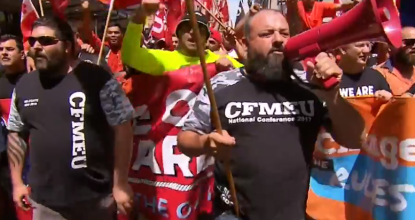
construction-protestIn CFMEU v BHP Coal Pty Ltd [2014] HCA 41, the employee was involved in a protest organised by the CFMEU where he held and waved a sign that said “No principles SCABS no guts”. Some employees of BHP Coal complained about the sign.  The general manager of the Saraji Mine where the employee worked found the word “scab” to be “inappropriate, offensive, humiliating, harassing, intimidating, and flagrantly in violation of BHP Coal’s workplace conduct policy”.  The employee was aware of this policy.  In response, the employee was terminated.

BHP Coal argued that the decision was based on “manner” in which the employee had taken part in the protest, not because he had decided to engage in a CFMEU strike.

The primary judge disagreed, holding that because the adverse action was based on the sign which the employee held and waved, this activity must be taken as one of the reasons for the action.   The High Court of Australia, by a three to two majority, found the primary judge was incorrect, and had “wrongly added a further requirement to s 361, namely that the employer dissociate its adverse action completely from any industrial activity”.

A similar issue was heard in CFMEU v Endeavour Coal Pty Ltd [2015] FCAFC 76, where the employee had been employed on the weekend roster for over five years.  In this time period, he had taken 15 absences, amounting to nearly 30 days.  The employee was moved away from the weekend roster, which had suited the employee and been of financial benefit to him.  Endeavour Coal conceded that this action was taken ‘because’ of the absences, but argued that this decision was purely motivated by operational reasons – as absences on the weekend shifts were much harder to rectify.  The argument was that the adverse action was ‘because’ of the exercise of the workplace right, but not ‘because it was a workplace right.  The majority of the court agreed, Bromberg J stating that a distinction could be drawn between the employee’s absences, and the ‘character’ of those absences.

The current authorities therefore suggest that the adverse action required to ground a breach needs to be ‘because’ of the protected activity, and not merely that the adverse action was taken ‘because’ of some instance of the protected activity arising.  Many people in the legal community consider that the Federal Court have gone too far in this decision.  However, the High Court did not give the CFMEU leave to appeal.

Those of us that are looking for clarity around the word ‘because’ will therefore have to wait for the next chapter to unfold.

March 2

Internships – are they legal?

When discussing Industrial relations, an issue that has often fallen through the cracks is that of internships.  In many sought after and prestigious professions (including law – see my previous post on this here) it has become commonplace to expect prospective employees to give their time to employers without remuneration.  Generally, other than in specific circumstances,  this practice is unlawful.

While there is no question that a young person volunteering their time to further their knowledge and experience in a certain industry is a good idea, there is currently enormous scope for employers to unlawfully exploit high levels of competition at career entry levels. It would seem that the more lucrative and prestigious a certain career appears to graduates, the more this exploitation is possible. In a recent finding of the Federal Circuit Court a media company, Crocmedia Pty Ltd, were found liable for breaches of the Fair Work Act in failing to recognise that their “interns” were actually employees.  Pecuniary penalties were imposed, in spite of the fact that the employer had already agreed to repay the employees their missing entitlements.    High levels of competition between prospective employees often create a willingness among them to provide services or to ‘prove themselves’ for free.  However the important  fact that employers need to keep to remember is that the statutory entitlements provided by the Fair Work Act and the Modern Awards cannot be waived by employees, even those seemingly desperate for career advancement.    For those employers for whom ‘internships’ are an essential part of their industry, the exceptions contained in Fair Work Act in respect of ‘Vocational Placements’ should be read carefully.  The Fair Work Ombudsman has published the following guidelines on their webpage:

Generally, the longer the period of placement, the more likely the person is an employee…

Although the person may perform some productive activities during the placement, they are less likely to be considered an employee if there is no expectation or requirement of productivity in the workplace…

The main benefit of a genuine work experience placement or internship should flow to the person doing the placement. If a business is gaining a significant benefit as a result of engaging the person this may indicate an employment relationship has been formed…

Unpaid work experience placements and internships are less likely to involve employment if:

    • they are mainly for the benefit of the person
    • the periods of the placement are relatively short
    • the person is not required or expected to do productive work
    • there is no significant commercial gain or value for the business derived out of the work.

In summary, if the internships are short,  primarily for the benefit of the person, and contain no expectation of productivity or commercial gain to the employer, then they are likely to be offered by anyone in industries that are highly competitive for jobs.

Ironically, a genuine internship is only likely to be offered by  the genuinely altruistic employers, or those for those industries that are experiencing skills shortages, or struggle to recruit employee interest.  Those careers genuinely perceived as lucrative or prestigious are firmly outside this category.

* Helen Carter is the Director and founding solicitor at PCC Lawyers, a team of employment practitioners based in Sydney, with many years of combined knowledge and experience in workplace law, industrial relations, workplace investigations and training.  They provide a high standard of excellence and an exceptional level of personal service to a variety of clients in the Sydney metropolitan area, Central Coast, regional NSW and interstate.