May 31

Managing workplace relationships: What we can learn from Barnaby Joyce

Everyone’s favourite Kiwi/Australian politician Barnaby Joyce has been in the spotlight again recently due to his upcoming interview with his partner Vikki Campion on Channel Seven’s Sunday Night program. From an employment law perspective (we always see things from an employment law perspective), it has again brought to light the topic of workplace relationships. No doubt you would recall that in February in response to the Joyce-Campion relationship, Prime Minister Malcolm Turnbull responded by banning all sexual relationships between ministers and their staffers. But is this suitable for other Australian workplaces, or is this delving a little too far into the private lives of employees?

Relationships and workplace romances have traditionally been a very sensitive issue with many employers unsure how much, or how little, they should get involved. On the one hand, they have a significant interest in not only ensuring a happy productive workplace (which may not be the case should a relationship sour) and avoiding conflicts of interest, but also an obligation to their employees in relation to sexual harassment and their health and wellbeing generally. On the other hand, many employers would be reluctant to tell consenting adults what they can and cannot do in their own time, not to mention questioning the extent to which any intervention would be enforceable anyway.

37053088 - young woman using water dispenser at officeMost Australians will know of someone who has met a significant other in the workplace (there’s clearly something romantic about the water cooler and the photocopier). So whilst employers should not try and stop workplace relationships, as this would be unlikely to work anyway, there are certainly steps they can take to mitigate legal risk and also to minimise potential disruption in the workplace. One such step that employers can take is implementing a ‘Disclosure/Workplace Relationships Policy’ and a ‘Conflict of Interest Policy’. These policies should, at a minimum, address the following key issues:


1. Require self-disclosure

Employees should be required to disclose any relationships to a suitable person, such as a HR manager. A discussion can then be had about any necessary changes that may be required in order to minimise risk or disruption in relation to the relationship. The HR manager may require the employee to outline that the relationship will not influence their work or the business.

  1. Manage any actual, or perceived, conflicts of interest

Once a disclosure has been made, changes in the workplace may need to be made to manage any actual, or perceived, conflicts of interest. This is especially the case where a relationship has formed between managers and their subordinates. Common solutions to managing conflict of interest may include reassigning one or both staff members to different departments, or removing managers from any involvement in decision making regarding performance or promotion where it relates to their partner.

  1. Beware of power imbalances

Whilst employers should generally avoid outright banning relationships, in some circumstances it may be inappropriate for the relationship to continue. For instance, in small businesses it would be impossible to shift either employee to a different department, so from a conflict of interest perspective, the employees may face a difficult decision between continuing in their role, or their relationship.

Similarly, a high level executive such as a CEO or partner involved in a relationship with a very junior employee such as a graduate may be discouraged so as to avoid any claims to favouritism or the potentially messy fallout should the relationship sour.

  1. Outline what is, and is not, acceptable behaviour in the workplace

Whilst employers should not try and stop relationships between employees, they can certainly manage the way it manifests in the workplace. The last thing that an employer would want is for a new relationship to spill over into the workplace, making other staff uncomfortable, and affecting morale and productivity. As such, the policy should clearly outline that all staff must interact in a professional manner at all times in the workplace. This means there should be no inappropriate physical contact (such as kissing) and personal discussions should be limited.

The policy should also address sexual harassment, and outline that although individuals may have been in a consensual relationship, that does not mean that sexual harassment may not occur when the relationship ends. Employers have a duty of care towards their employees to ensure their wellbeing, and may be vicariously liable should sexual harassment occur.

  1. Outline the consequences of failing to follow the policy

From an employer’s perspective, there are serious issues, such as conflict of interest and sexual harassment, that can be related to workplace relationships. As such, any policy on these issues needs to expressly state that disciplinary action, including dismissal, may be taken where the Disclosure/Workplace Relationships Policy or Conflict of Interest Policy is breached. This includes where an employee has failed to adequately disclose a new relationship.

Indeed, a case in the Fair Work Commission in 2015, M v Westpac Banking Corporation [2015] FWC 2087, rejected an unfair dismissal claim where a Westpac manager was fired for failing to disclose an affair with one of their subordinates.

Final thoughts

Managing relationships in the workplace need not be the minefield that employers may expect. There are some relatively easy steps that can be implemented to help manage workplace relationships that do not deprive consenting adults of their freedom and dignity to do what they please in their own time. And who knows, if a properly managed and adhered to Disclosure/Workplace Relationships Policy had been in place in Parliament House, maybe Barnaby would still be Deputy Prime Minister.


May 29

Is the word “bullying” being overused in the workplace?

There is no doubt that workplace bullying can be a serious matter for employees and employers. It can lead to higher rates of depression and anxiety for employees as well as physical health problems such as cardiovascular disease, migraines and obesity. Bullying in the workplace also has detrimental effects for employers as it can lead to increased absenteeism, lower productivity and the erosion of team morale. This is estimated to cost Australian companies between $6 billion and $36 billion each year.

As an employment lawyer, I have noticed recently that the term “bullying” is being used rather loosely to describe a range of interactions in the workplace. Often, “bullying” is used simply to describe an experience that a person does not like, whether it be rude behaviour or being told to do something by their boss, rather than actually meeting the ordinary or legal definition of the word.

So, with that in mind, what is, and is not, workplace bullying?

What is workplace bullying?

I see constant references to alleged bullying in Fair Work matters. Our clients also frequently face workers compensation claims where an employee has alleged a psychiatric injury due to “bullying”.

Many employees and employers do not appreciate that the reasonableness of workplace behaviour, and whether it constitutes bullying, is judged objectively rather than being based only on an individual’s own subjective perception of the situation. The Fair Work Commission has consistently held that there cannot be a finding of workplace bullying based solely on an employee’s subjective belief that they have been bullied.

Common examples of behaviour that are workplace bullying include:FWC-image

  • Using abusive, insulting or offensive language towards another person
  • Deliberately excluding another worker from workplace activities
  • Aggressive or intimidating conduct
  • Playing malicious practical jokes
  • Spreading rumours

What is not workplace bullying?

Unfortunately, the term bullying in the workplace seems to be increasingly used to describe behaviour a person does not like or that they feel is an infringement of their rights (when in fact it is not). A manager providing feedback to an employee critical of their work? I’m being bullied. HR investigating an allegation against an employee of misconduct? Yep, also bullying.

Except, it’s not.

Employers need to be able to exercise their rights and obligations to give their employees directions in relation to their work and manage poor performance. Reasonable management action carried out by a manager in a reasonable manner is not workplace bullying.

For instance, if an employee is not meeting their KPI’s or is not completing work to meet deadlines, a manager has every right to provide feedback (in a reasonable manner) to that employee to address their underperformance. Unfortunately, for certain types of employees this falls into the category of “behaviour I do not like”, so they will often react and claim that this management action is bullying. Employers and managers should not be disheartened, as they are not “bullying”, but simply performing their role.

Final thoughts

Employers and managers should not avoid giving critical feedback to their staff out of fear of being subjected to a bullying complaint. An employee’s subjective belief that they have been bullied is not enough to make a finding that workplace bullying has occurred. The Fair Work Act recognises that employers and managers are entitled to perform reasonable management action in a reasonable manner. A key factor in managing complaints of bullying, and the overuse of the term bullying, is educating employees by having a workplace policy that provides clear examples of what is, and is not, workplace bullying.

Employees should avoid using “bullying” as a synonym for “behaviour I do not like”. This loose use of the term “bullying” detracts from actual instances of workplace bullying and waters down the true, very serious meaning of the word.

April 30

Junior pay rates in modern awards: Are young people being ripped off?

A “fair go all around” has long been an underlying principle in the Australian industrial relations system. However, under many modern awards, employees aged between 15 and 20 years receive only a portion of the full adult wage despite often undertaking the same work as an adult. For those junior workers who do not fall under a modern award, the national minimum wage operates to a similar effect. This begs the question, are these young workers really getting a fair go all around?

Why are young people on a lower wage?

The justification for paying young people a lower rate for the same job is that it is actually for young people’s benefit. For instance, a lot of young people seeking work are generally inexperienced and unskilled. An employer thus needs a reason to employ them over someone who has experience and skills which are qualities that older workers often bring to the table. Therefore, lower wages for young people is said to encourage employers to employ young people, providing more entry level jobs for young people whilst compensating employers for the higher training costs associated with younger workers.

Should lower wages for young people be abolished?

If the youth wage were to be abolished, then the rationale goes that employers would have no incentive to employ young, unskilled workers and as such, entry into the job market would become increasingly difficult and youth unemployment would sky-rocket. The 1999 Productivity Commission Report on the youth wage confirmed as much. That report found that a ‘1% increase in youth wages would result in a decrease in youth employment from about 2-5%’. The findings of this report have consistently been touted in support of indexed youth wages.

How are adults with no experience treated under modern awards?

The justification for paying young people junior rates regardless of their skills and experience starts to unravel with a few examples. For instance, a 19-year old might have worked as a kitchen hand for 3 years but will receive 85% of the adult rate under the General Retail Industry Award 2010. In contrast, a 26-year old who has no experience working as a kitchen hand will receive the full adult wage.

Similarly, an 18-year old starting their first job at a fast food restaurant as a casual will receive $20.08/hour which is 80% of the adult wage under the Fast Food Industry Award 2010. However, a 23-year old also with no experience will receive the full adult wage of $25.10/hour. Although the 18-year old and 23-year old both have no experience, the 23-year old is still paid the adult wage.

Indeed, the Fair Work Commission (FWC) has somewhat recognised the inequality generated by the junior rates. In March 2014, the FWC decided to increase the Award wage for 20-year old employees that were covered by the General Retail Award. The ruling ensured that 20-year old employees were now paid the same rate as adults provided they had worked with the company for 6 months.

So, what is the solution?

If the whole point of junior rates is to incentivise employers to employ inexperienced and unskilled workers, then the solution may be to pay new and inexperienced workers a lower rate. For instance, in New Zealand, there is a “starting-out wage”. This is paid to 16 and 17 year old employees for the first six months of continuous employment with their current employer and is equal to 80% of the adult minimum wage.

At present, the system is not ideal and can result in unfairness to young people who are performing the same work as similarly experienced and skilled adults but are not receiving the same pay. I will be interested to see how this area of law develops in the coming years as the FWC strives to balance the notion of “a fair go all around” with facilitating entry into the job market for young, unskilled workers.


January 29

The Sydney Rail Strike – why the Fair Work Commission had no choice.

As an industrial lawyer, it was probably a mistake logging onto social media on Thursday, in the aftermath of the Fair Work Commission’s order in relation to the RTBU strike proposed on the Sydney rail network.  Social media in the modern political era is rarely a place for nuanced, informed or intelligent discussion.  Rather, it has become a place where people from both sides of politics (there are only two sides by the way) do little more than ‘like’, ‘share’ and ‘comment’ on pieces of web content that conform with their side’s view, and to dismiss (or troll) anything that doesn’t.

The backlash to DP Hamberger’s order was typically fervent.  For example, Greens politician Adam Bandt stated: “The right to strike is under threat in Australia. We stand with rail workers who are organising for safe and fair working conditions and better pay [fist emoji]”. Mr Bandt’s post led to a barrage of commentary, with common references to the ‘Unfair Work Commission’, a comment describing the Commission as ‘Liberal stooges’ (which for the record, has not been my experience of appearing before the Fair Work Commission), a comment that the rail workers had been ‘spat on’ by the Commission, and perhaps my favourite: ‘fascist legal controlled by state government is on the rise.”
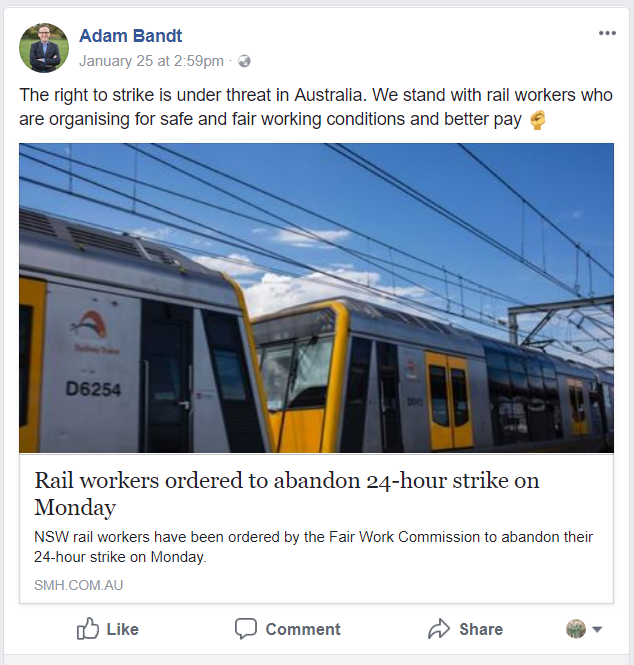
Bandt post

Overall, the message of the commentary seemed to be that the prevention of the strike was yet another example of the ‘dystopian capitalist roll-back’ currently gripping the societies of the western world.  In particular, it appeared as a regular view on Facebook that the legislative power to prevent this industrial action was new, or somehow recently introduced by government. This is plainly wrong, and deserves correction.

It is with some irony that these industrial events centred around the Australia Day weekend. In my view, industrial relations is perhaps the one area of Australian politics of which we can be very proud. By international standards, Australia has always committed to and maintained a genuine balance. From the very early years of Australian political history, we have attempted to craft a system with appropriate harmony and tension between employer and employee interests. Consistent with Aussie informality, we call this ‘a fair go all round‘.  Most notably, the Concilation and Arbitration Act 1904 (Cth), was one of our very earliest, and most important, Commonwealth enactments.  Over the subsequent century, maintaining this balance between the employer and employee relationship has been a key part of our legal and political discourse.  Three of our most famous and important High Court Cases concerning the scope of Commonwealth power: the Engineers Case, the Boilermakers Case, and the Work Choices Case, have each originated as disputes over employment agreement making.  The Coalition have only made one concerted attempt in the modern era to reform industrial relations in a manner which genuinely undermined the power of employees. This effort, in 2005, was the primary cause of the immediate demise of the most dominant Coalition government in modern history, following an ALP landslide in 2007. The modern Coalition, who seem unashamed to deny climate change, lock up infant refugees, and do everything in their power to block marriage equality, have spent over five years in office hedging around industrial relations like it is a poisoned chalice. It is therefore safe to say, that the value of the employment relationship sits at the very heart of our political and social consciousness.

In the United States, liberals often cite the Australian system as a positive example of how substantial employee minimum wage and entitlement provisions can coexist with sustained economic growth.  On the other hand, countries such as Greece have demonstrate that uncontained freedom and exercise of industrial action can have broadly detrimental consequences to economic and social well-being.  To this end, both ‘sides’ of politics should remember that we have always (at least in this one area of law) achieved a relatively healthy political compromise.

45497517 - sydney city trafficIt is not often that I go out on a limb to defend the Commonwealth executive. But on this occasion, I am happy to be the first to opine that there was nothing controversial about Thursday’s order by the Commission.  And nothing about it was inconsistent with the similar orders made in the late 1990s or early 2000s, under the equivalent provisions of the Workplace Relations Act 1996 (Cth).  Further, I acknowledge that the Fair Work Commission members are political appointments, and Deputy President Hamberger was appointed to the Commission by a Coalition government, and has an industry, rather than union, background. However, I believe that the decision was non-partisan, and that any one of the many Commissioners or Deputy Presidents appointed from union backgrounds by Bill Shorten during the Rudd / Gillard government would have come to the same or similar result.

The reason for this, is that the rationale for making the order is premised on very narrow grounds, contained in section 424 of the Fair Work Act 2009 (Cth).  This has been feature of Act for a decade, and the various predecessor legislative instruments for generations.  Industrial action has never been ‘protected’ under Australian Law when it has the capacity to ‘threaten the welfare of part of the population’, or to cause ‘significant damage to the Australian economy or an important part of it’.

The Deputy President held that the strike would threaten welfare of part of the population, recognising the number of people that rely upon the trains to go about their daily business, and making specific reference to the already congested conditions of Sydney roads, which are dangerous as they are, without thousands of additional cars, busses, and pedestrians.

However, the Deputy President also held that the strike would significantly damage the economy of Sydney. To understand the meaning and importance of this provision, we need to look a little more deeply at the concept of ‘the economy.’  In the politically polarised world of ‘like’ and ‘share’ social media, ‘the economy’ is generally a code word for interests of the established rich, in particular the interest of ‘getting richer’.  In the context of an ever-widening equality gap, this often equates to the poor getting poorer.  The ‘economy’ is too often used by the political right in the ‘Republican / Trump / trickle down’ sense of the word, to scaremonger and justify cruelty or lack of attention to the underprivileged.  When striving for social justice therefore, it is very easy, and often justified, to disregard ‘the economy’ as an irrelevant consideration.

However, ‘the economy’ in its ordinary sense means a lot more than this, and the Fair Work Commission are correct not to adopt this inflammatory or politically supercharged meaning.  The meaning of ‘economy’, in accordance with the Macquarie Dictionary is:

……… 4.  the management, or science of management, of the resources of a community, etc., with a view to productiveness and avoidance of waste: (national economy). 5. the disposition or regulation of the parts or functions of any organic whole; an organised system or method…..

To this end, the ‘economy’ is not merely the interests of the political right, or of those that own the ‘means of production’.  It is all of us.  Our economy is the sum total of our collective financial interests.  This necessarily includes, and is sometimes little more than a collective appreciation for our individual financial interests.  The New South Wales Government, may not stand to lose that much from a 24-hour strike, but many people in Sydney do.

To see an example of the potential economic effects of the Sydney rail industrial action, I had to go no further than my office’s local station, at St Leonards.  On Thursday, during the reduced timetable due to a union overtime ban, the food court was already deserted at lunch time.  Most of these businesses are run by self-employed, small operators, paying high rents.  The casual employees had been sent home, and the businesses were operating on skeleton staff.  These self-employed operators, and their casual employees were out one day’s pay, in a week when they had already lost one day’s pay to the public holiday. If the strike had gone ahead, this would have been three consecutive business days’ pay.  The knock-on effects are obvious.  For some of these employees, this could be the rent that is due next week, food for their families, or the difference between buying their kids’ new school shoes in time for the start of term.  Or, perhaps trivial to some, it would mean merely missing out on the few, well deserved, beers they had planned to have on the Australia day weekend.  Further up the chain, this equates to less revenue for the grocery store, the shoe store, and the pub.

RTBUIn many ways, it would be useful to adopt Lord Atkin’s famous ‘neighbour’ principle when we discuss the term ‘economy’, rather than seeing it as only applying to the interests of the powerful or wealthy companies and individuals that appear to control the economy.  When we do so, it takes on a different complexion.  While the members of the RTBU may wish to forego a day’s pay to secure a 6% rather than 2.7% increase, I don’t see why the casual employees at the St Leonards food outlets, nor the self-employed operators, should do so, either voluntarily or otherwise.  And these are only the first level ‘economic effects’ that are visible and obvious, before moving beyond one railway station.  When magnified to the entire network, and city, the exponential knock-on effects are obvious. When we assess the broader potential losses to those people relying on the rail network, or those relying on the roads, to make their income, or even just the loss of productivity to those business requiring their employees to attend work, the impact was potentially enormous.  Clearly, this proposed strike was never about workers exercising leverage over an employer, it was about workers exercising leverage over an entire community, including other workers, many of whom have no security of income.  John Classen, on behalf of the RBTU, issued a media statement on Thursday prior to the order encouraging employers to ‘give their employees a day off on Monday’.   While to your average full-time office worker, the idea of extending the holiday weekend seems like a pretty neat idea in principle, the costs of this on the economy (in the ‘neighbour’ sense of the word) would be astronomical.  If this this is the union’s genuine position on how the strike should have been handled by Sydney employers, it is very hard for the union to then argue that they were not cognisant of the effects of their proposed industrial action on the wider economy.  This is the type of leverage expressly prohibited by the Fair Work Act 2009 (Cth), and there is nothing new about this.

While the very existence of industrial action depends upon economic leverage, a just and balanced society needs mechanisms to determine what leverage is fair to the affected parties who are not involved directly in the specific employment relationship.  While workers are entitled to cause or to threaten to cause some economic harm to their employer to forward their own interests (as shown in cases such as BHP Coal Pty Ltd v CFMEU [2001] AIRC, 17 April 2001), we should stop short of allowing unions to leverage wider economic harm against their members’ own employment interests.

I am grateful to the train drivers that get me to work every day, and I recognise that they have significant concerns over the way they have been treated. I genuinely hope they ultimately achieve their industrial goals.  However, with respect, it just has to happen some other way. Contrary to what you might read on Facebook, the leverage that would have been caused by their proposed strike, has never been a leverage that they were entitled to exercise.


January 24

Growing support for a workplace response to domestic violence

Violence against women is now recognised as a serious and widespread problem in Australia. Whilst awareness has increased of domestic violence as a community issue, there is still much to be done to support victims. 2017 saw an increase in support for a workplace response to family violence, through the inclusion of family and domestic violence leave in all modern awards, or the National Employment Standards. At a minimum, unpaid leave looks likely to be inserted into modern awards in 2018, meanwhile the unions, Greens and Labor Party continue to push for paid leave.

What is domestic violence leave and why is it needed?

Family and domestic violence leave provides victims of violence by a family member time off work to attend legal proceedings, counselling, and medical appointments, as well as relocating or making other safety arrangements. Paid family and domestic violence leave can ensure financial security and support victims escaping abusive relationships.

Some large private sector employees, such as Telstra, KPMG, Woolworths, IKEA, NAB, Westpac and PwC, currently provide paid family and domestic violence leave entitlements. In addition, most State governments have domestic violence protections for their public servants, some of which include paid leave. However, the majority of Australian employees are reliant on a modern award for their minimum entitlements, and the unions are pushing to standardise workplace support.

ACTU’s application for paid domestic violence leave

In July 2017, a bid by the Australian Council of Trade Unions (ACTU) to have 10 days paid leave available to Australia’s two million award dependent employees, was rejected by the Fair Work Commission.

The Commission acknowledged that domestic violence is a significant problem in society, in the workplace, and for the national economy. It noted the inability of existing workplace entitlements to meet the needs of employees who experience domestic violence as their need for leave is often urgent and they may not able to request annual leave or flexible work arrangements at short notice. However, the Commission was not satisfied that ten days paid domestic violence leave was necessary to meet the objectives of the modern award and concluded that a cautious approach should be taken to the introduction of domestic violence leave, citing concerns over increased employer’s costs and the lack of data or evidence regarding the operation of such leave.

However, the Commission formed the preliminary view that an unpaid leave entitlement should be included in modern awards to enable victims to deal with the consequences of the violence. The Commission is currently reviewing submissions on the drafting of such a provision, such as what quantum of unpaid leave is appropriate, who can access it, and notice and evidence requirements.

Introduction of the Greens bill

In late November 2017, The Greens released draft legislation to introduce 10 days’ paid family and domestic violence leave as a new entitlement in the National Employment Standards (NES). The Australian Labor Party had previously committed to five days paid leave in the NES, but in response to the Greens bill, in early December, they raised their commitment to ten days.

Resistance to the introduction of paid domestic violence leave

The Coalition and some employer representatives have resisted the extension of paid family violence leave to all employees in Australia, through inclusion in modern awards or the NES. Their primary concern is that paid domestic violence leave would impose a significant and undue expense on employers, with the Australian Chamber of Commerce and Industry (ACCI) claiming it could cost employers as much as $205m to create just one day of domestic violence leave per worker per year.

A common objection from employer groups is that domestic violence is a societal issue, not a problem that is created by employers, and as such, a government funded national system of domestic violence leave is required, in the same manner as paid parental leave. Other opponents of the proposal argue domestic violence leave is just another union shakedown, and any paid family violence leave provisions will be abused to justify non-necessary work absences, i.e. it will become the new “sickie”.

There is also a concern that the current proposals might drive a further divide between the entitlements of permanent and casual employees. The paid family violence leave provisions currently available in some enterprise agreements generally only cover employees in full time or part time employment, when casual employees facing violence do not even have access to paid annual or sick leave entitlements. The ACTU submits that 51% of award-covered women are employed as casuals, so it is essential that casuals are included in any amendments. Otherwise, paid family violence leave will only serve to further incentivise employers toward casualisation of the workforce.

There is also recent research which challenges the effectiveness of paid domestic leave policies, with the conversion from policy into practice falling short. A survey of HR professionals published by the Australian HR Institute in September 2017 concluded that Australian workplace domestic violence policies don’t translate into practice. Only 14% of respondents currently report any form of specific training for supervisors and managers to help victims disclose domestic violence, and only 18% have any form of manager training to recognise victims of domestic violence.

Arguments in response

Research by the Centre for Future Work at the Australia Institute suggests that the costs of paid domestic violence leave is unlikely to impose a noticeable increase in labour costs for employers, and any costs are likely to be largely offset by benefits such as reduced turnover and improved productivity. Only about 1.5% of female employees and around 0.3% of male employees are likely to utilise paid domestic leave provisions, costing $80m to $120m per year. The massive discrepancy in cost compared the ACCI’s modelling, derives from utilisation assumptions, with the ACCI’s figures based on 25% of female and 10% of male workers accessing the leave each year. The ACCI utilisation rate is far greater than what has been experienced by employers who already have paid domestic leave provisions in place.

Supporters of paid family violence leave argue that there would be two tests to ensure the system is not open to abuse, and would restrict the incidence of leave-taking to subset of those workers who actually experience domestic violence. Firstly, the leave must be related to specific activities or events related to the violence, to support employees in their efforts to escape the violence. It’s not intended as compensatory leave for victims. Secondly, documentary evidence must be provided regarding the nature and timing of those events if requested, such as a note issued by police, a doctor, or a lawyer, for example.

With regards to casuals, the unions bid for paid leave to be included in the modern awards, and the Greens’ bill regarding the NES, both provide for paid leave entitlements to be extended to casual employees. Under the ALP’s proposal, casual workers would be entitled to unpaid leave.
Conclusion

The argument that paid family and domestic violence leave is too expensive has been refuted by the research which considers the actual experience of several Australian employers who have already implemented paid leave policies. It shows that in practice, paid leave entitlements are not frequently utilised, and any incremental costs are offset by the broader economic benefits.

The complexity of family violence requires a strategic approach by all levels of government, business, and the community. Developing a workplace response to domestic violence also requires support measures besides paid leave, such as training for managers to help victims disclose domestic violence, referral of employees to appropriate domestic violence support services, flexible work arrangements; and no adverse action or discrimination of the victims of domestic violence. Unless workplaces take measures to promote disclosure, and managers are trained to support their employees, the stigma already involved in revealing domestic violence is unlikely to dissipate, and the purported benefits and costs of providing paid family and domestic violence leave are unlikely to be realised in any event.


October 30

Dismissals ‘R’ Us: A New Trend in ‘shake down’ litigation putting commercial pressure on Employers

Following some emerging trends in representative conduct in the Unfair Dismissal jurisdiction in particular, the Fair Work Commission require broader powers to make costs orders, especially against lawyers and paid agents who bring, or continue, claims that  lack merit.

The Fair Work Commission’s power to make orders for costs under the Act are limited, primarily to situations in which an ‘unreasonable act or omission’ in the conduct of the matter causes costs to be incurred by the other party.  The threshold of ‘unreasonableness’ is high.  The traditional rationale is, that in a situation of power or resource imbalance, parties should not be deterred from litigation by the threat of costs orders. This is an essential feature of the ‘fair go all round’.  There would be limited utility in providing vulnerable employees with protection under or 3-2 of the Act, if access to litigation was inhibited by the same power imbalance that protection is designed to address.

FWC-imageHowever, the traditional disparity between parties has arguably shifted.  Access to free, or contingency based, representation, from unions, lawyers, or non-lawyer paid agents, is available to applicants to a level that it not available to respondents. And the involvement of these applicant representatives often mean that employers are uncomfortable proceeding without their own representation.  Efforts that have been made to simplify and lower the cost of termination disputes,  for the benefit of unrepresented parties, have encouraged the involvement of representatives acting outside the purview of the Legal Services Commissioner, and at times these representatives lack a thorough understanding of the provisions. In unfair dismissal applications, a push towards alternative dispute resolution has created an expectation on respondents that they should provide settlement options early in every single case, irrespective of merit.  Given the cost of legal representation for respondents, and the relatively limited compensatory level of each claim, it is rarely commercially sound to resist a claim past conciliation, even if the claim fundamentally lacks merit.  The high threshold of ‘unreasonableness’ in the costs provisions, has the effect of insulating applicants and paid agents from any consequences relating to the institution or continuation of unmeritorious claims.  Applications can be used to leverage a result commercially, with little regard for the actual provisions.   A divergence now exists between law in action, and law in principle.

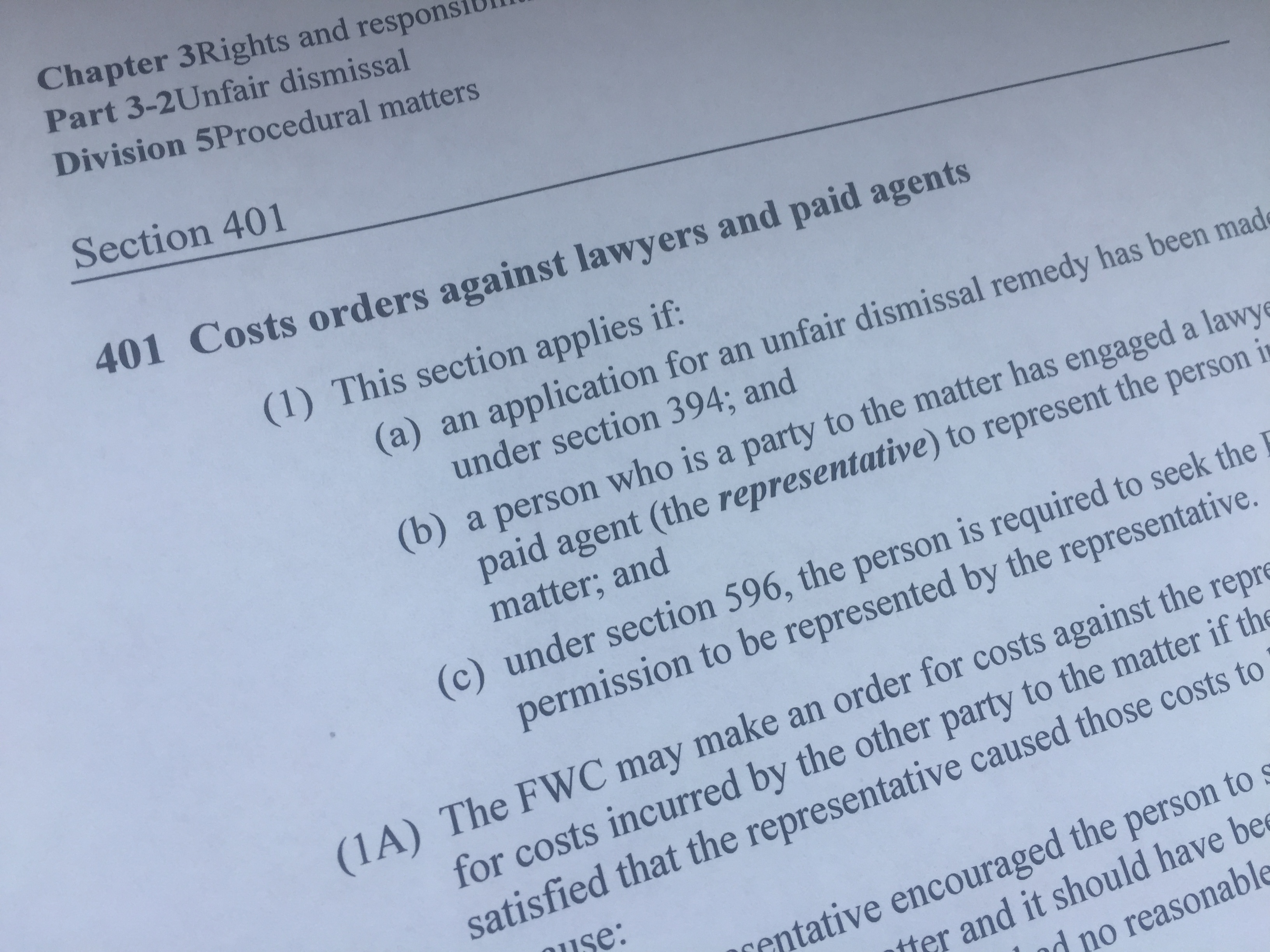
File 30-10-17, 4 26 34 pmMeanwhile, Unions are also excluded from section 401 of the Fair Work Act, because they are not required to have permission to appear.  Costs orders cannot be made against them when they act as representatives for their members.  This allows Union representatives a considerable litigious freedom, with limited responsibility.  For many years Unions have benefited from the receipt of civil penalties awarded against employers by the Federal Circuit Court and Federal Court. Unions therefore, have enjoyed a unique position in which they hold an incentive to bring claims on behalf of their members, yet no disincentive against vexatious and unreasonable conduct.

This applicant power, and the divergence between legal reality and legal principle, flows back to the workplace. The legislative provision that currently dictates whether a dismissal is ‘harsh, unjust, or unreasonable’ is section 387 of the Fair Work Act. This is purposed as both a general deterrent to employers, as well as practical guide to the dismissal process.  However, employers are experiencing increasing levels of ‘shake down’ litigation, and are very aware of these commercial factors. This has created a disincentive to regard the section 387 guidelines in practice. As employers become more and more accustomed to having to settle claims, there is little point in performing dismissals fairly in the first place.  In this respect, the Act is failing to achieve its purpose.

65145986_lThere is no easy solution, but very slight changes in the costs jurisdiction may have the effect of addressing this emerging imbalance.  These changes should focus on regulating the conduct of representatives. Unrepresented applicants should remain largely insulated from costs orders.  However, a broader scope for costs orders against all representatives would be desirable to further the purposes of the Act.  These can be effected by three steps.  Firstly, added procedural obligations in the Fair Work Commission Rules, for representatives in relation to both the bringing, and resisting, of claims.  These may include representatives providing undertakings on the original application and response that the claim is brought or resisted with reasonable prospects of success. Further, instructions on a contingency or pro bono basis should be disclosed to the Commission, and parties making that disclosure should be compelled to apply to the Commission for permission to cease representation.  Fair Work Commission Conciliators and parties should be given broad power to apply to the Commission for intervention in the event that either the procedural obligations are breached, or if it appears that a claim has been brought without merit.

Secondly, the phrase ‘unreasonable act or omission’, in section 401 of the Act, should be defined to further include any breach of the new procedural obligations for representatives. This would broaden the powers of the Commission to make costs orders in specific circumstances, and encourage greater respect for the legal provisions from many paid agents and lawyers.

Thirdly, Unions should no longer be protected from costs orders by the Act.  Like all other agents in this space, they should be held responsibilities for any unreasonable conduct.