November 28

Work Christmas Parties – Employees May Risk More Than Their Dignity

The silly season is fast approaching and the annual work Christmas parties will be starting to happen. The combination of end-of-year cheer and alcohol can create some less than ideal situations for employers. Most employers will start the new year with a ‘forgive and forget’ attitude to the embarrassing dancing or terrible karaoke singing. It is also reasonable to expect that one or two employees in any given year will drink a little more alcohol at the end of year party than they initially intended. While this may involve a loss of dignity, generally this conduct is regarded by both employers and colleagues as part of the fabric of the modern workplace. But what happens when an employee goes too far? At what point does ‘drunken cheer’ become a disciplinary issue.

Employees should be aware that their behaviour at these events may affect their employment. Their behaviour can result in the issuing of a warning, a final warning or worst-case scenario, termination of their employment, even if the event occurs after work hours.

However, employers should not discipline an employee for out of hours conduct too hastily. An employee may only be disciplined for out of hours conduct in circumstances where the situation is found to be work related.

The requirements for when conduct is work related was set out in B. Rose v Telstra Corporation Limited [1998] AIRC 1592, and are:

  • objectively the employee’s conduct is likely to seriously damage the employer/employee relationship;
  • the employer’s interests are damaged; or
  • the employee’s conduct was incompatible with their employee duties.

The Fair Work Commission recently provided a reminder of this outcome in the case of Mr Bradley Drake v BHP Coal Pty Ltd [2019] FWC 7444. The case involved two unfair dismissal applications of Mr Drake and Mr Bird. At their crew’s Christmas party last year, Mr Drake and Mr Bird were involved in a verbal and physical altercation with another employee, Mr Maunder. Mr Drake further admitted to making offensive comments to a Ms H, saying “do you have fake tits?” and “all the girls have them, you can’t come to [excavator] strip 44 unless you have fake boobs”. Mr Drake and Mr Bird asserted that they did not know that the party was organised by BHP or that BHP had contributed to the Christmas party. They believed it was an employee organised event and if they had known they would have acted differently.

BHP commenced an investigation into the situation after Mr Maunder made a complaint that he had been punched by two employees at the Christmas party. During their interviews both Mr Drake and Mr Bird said they could not remember if they had punched Mr Maunder. Following the investigation BHP found that both Mr Drake and Mr Bird had punched Mr Maunder and they were both terminated. Mr Maunder was also terminated but requested the opportunity to resign which was agreed to.

Deputy President Asbury found on the balance of probabilities that Mr Bird did not punch Mr Maunder but was involved in a verbal altercation with Mr Maunder which ended in both Mr Bird and Mr Maunder grabbing each other by their shirts. It was found, on the balance of probabilities, that Mr Drake started the verbal altercation with Mr Maunder and that Mr Drake punched Mr Maunder more than once. Additionally, Deputy President Asbury held that the Christmas party had the requisite connection to BHP and that it was more probable than not that Mr Drake and Mr Bird knew that the Christmas party was organised by BHP. Deputy President Asbury provided that if this was incorrect there was sufficient factors to establish that the event was work related:

  • 90 people attended, consisting of 60 employees and 30 family members;
  • they were gathered at one venue;
  • they were gathered for a common purpose, to celebrate Christmas;
  • the employer/employee relationship will be seriously damaged when an assault between two employees happens in a public place in front of other employees;
  • where a large group of employees gather to drink alcohol in a public place in a town where BHP is a large employer the action of employees can damage the interests of BHP; and
  • members of the public being present will increase the damage to BHP’s interests.

Deputy President Asbury stated that employees should not need to be told that when they gather in large numbers in a public place after work hours that their employment may be at risk if they get into altercations, either with another employee or a member of the public.

It was held that Mr Drake’s dismissal was valid and not unfair. Mr Drake had breached BHP’s Charter of Values and the Code of Business Conduct. Whereas, Mr Bird’s dismissal was held to be unfair as it was harsh, unjust and unreasonable. It was harsh because it was disproportionate to the gravity of Mr Bird’s conduct, Deputy President Asbury stated that the conduct, verbal altercation and grabbing Mr Maunder by the shirt, amounted to a final warning, and the dismissal affected Mr Bird’s personal and economic situation. It was unjust because Mr Bird was not guilty of the misconduct alleged to be the reason for his dismissal and because BHP incorrectly found that Mr Bird had punched Mr Maunder. It was unreasonable as the inferences used by BHP to find that Mr Bird had punched Mr Maunder were not available. An order for Mr Bird to be reinstated was issued. However, Mr Bird’s conduct at the Christmas party and during BHP’s investigation resulted in a deduction of 75% in the order for lost remuneration.

Take Home

Employees should be aware that their actions at the work Christmas party, or other work functions, can affect their employment.

Employers should carefully consider the criteria to establish that the function is work related before disciplining an employee due to conduct at out of hours functions. Employers should also take measures (including undertaking an investigation if appropriate) to substantiate any claims of employee misbehaviour, as well as providing appropriate procedural fairness to any employee throughout any disciplinary process. Procedural fairness requirements include putting the employers concerns relating to the employee’s conduct to the employee, and giving them an opportunity to respond prior to making any final decision, and providing the employee with the opportunity to have a support person present at all meetings in which termination of employment may be an outcome.


July 8

To text or not to text? That is the question.

Technology has fundamentally altered the way in which we interact. Five billion people use text messages globally every day.  Socially, it is one of our primary ways of interacting. Staggeringly, if you are dating someone born after 1984, there is a 53% chance that if that person ends your relationship, it will come to an end via some electronic device, rather than a face to face meeting.  Welcome to the modern world.   

For many business people, SMS is one of the primary ways that they interact with their employees when they are not at work.  So if it is becoming normal for romantic relationships to end via SMS, is it appropriate for an employment relationship to end this way?  Last week, two senior members of the Fair Work Commission have independently answered this question with an emphatic ‘No’.

A year ago, a colleague of mine blogged about the issue of face-to-face dismissals, following a dismissal vial email being challenged at the Fair Work Commission. The effect of that blog was to advise our readers of the Fair Work Commission’s view that communicating an employee’s dismissal other than via a face-to-face meeting were only to be used in ‘rare circumstances’. In these two more recent cases last week, the Fair Work Commission has shown us that nothing has changed in the past year.  

In the first case, Kurt Wallace v AFS Security 24/7 Pty Ltd [2019] FWC 4292, Mr Wallace, a casual security guard, was dismissed by text message. AFS Security 24/7 Pty Ltd submitted that as a casual employee they could dismiss Mr Wallace at any time and for any reason. In defending their use of a text message the employer submitted that text messages were the ‘normal method of communication’ for the company and that the preference for text messaging was a ‘generational thing’.

Commissioner Cambridge stated that an employee should be dismissed face-to-face. The use of text messages or other forms of electronic communication should only be used if there is a ‘genuine apprehension of physical violence or geographical impediment’.

The small size of the company and common use of text messages in communicating with its employees did not provide an excuse for the company not to comply with its obligation to communicate the dismissal in person.

The second case, Van-Son Thai v Email Ventilation Pty Ltd [2019] FWC 4116, involved Mr Van-Son Thai, a first class sheet metal worker, who was informed of his dismissal via text message. Mr Van-Son had worked for Email Ventilation Pty Ltd for 12 years and had refused to accept an offer of decreased wages.

Deputy President Sams, another very senior member of the Commission, confirmed the same view as his colleague Commissioner Cambridge, in finding that it is inappropriate to inform an employee of their dismissal via text message, email or phone. It is only in very rare circumstances that it would be appropriate to do so, such as when an employer feels that their safety is threatened.

Further, Commissioner Cambridge and DP Sams expressed that dismissal has a significant impact on employees. Employees should accordingly be treated with dignity and respect during the dismissal process.  Commssioner Cambridge described the actions of the employer in this case as “unnecessarily callous”; DP Sams describing the dismissal in his case as being “disgraceful and grossly unfair”.

In both cases it was found that the termination of the employee was harsh, unjust and unreasonable, and significant compensation orders were made.

What Employers can Learn from these Cases

While it can be a difficult conversation to be having in person, and even though use of electronic methods of communication in business is increasing, an employee should always be informed of their dismissal in person. The size of the business or their main method of communication does not negate this obligation. Basic decency dictates this, and we cannot see this changing any time soon, despite society generally embracing technology more and more each year.

Using electronic means of communicating dismissal should only be used if the employee has been given ample opportunities to meet face to face and refuses to meet or there is a threat to safety or there are geographical limitations.

In our experience from a practical context, providing a courteous and open forum to communicate the employer’s decision, greatly decreases the potential for employees to be aggrieved enough by the outcome to consider challenging the dismissal legally.

A dismissal does not have to be affected in an adversarial or combative manner. Often, having a respectful conversation, which allows the employee to preserve their dignity, can be the best protection against the issue escalating unnecessarily. Even if the employee becomes abusive or emotional, the employer/manager is well advised to remain as calm as possible.

It is also recommended that employers provide the employee with an opportunity to have a support person present. Contrary to common belief, the Fair Work Act does not create a positive obligation to provide this.

The employer only must not ‘unreasonable deny’ the employee a support person. In our experience, however, the best practice is to actively provide an employee an opportunity to have a support person present during a termination or disciplinary meeting. While an employer does not have to unreasonably delay the meeting for the employee to find a support person. If a reasonable request is made, the request should not be refused.

The employer is entitled to impose conditions on who the support person is (for example not a lawyer) and also require a confidentiality agreement to be signed by the support person. The support person is not an advocate for the employee and in most cases should not actively take apart in the meeting. If they do repeatedly interrupt or intervene, it is appropriate to ask the support person to leave.

Final Note

Employees will often bring termination claims where there is no merit, simply because they are aggrieved at the way they have been treated by an employer. Irrespective of the lack of merit, these claims are inconvenient and costly.  At other times, employees will walk away from a potentially valid claim, often because they hold no grudge, and merely wish to get on with their lives.  In our experience, the best protection against potential legal claims arising from termination of employment, is to treat your employees with dignity and respect. We may have become a society of disconnected ‘text-aholics’, but when it comes to the dismissal of an employee, the basic rules of common sense and human dignity still apply.   

July 10

#TimesUp on inappropriate workplace behaviours

The Fair Work Commission is showing little tolerance for inappropriate workplace behaviour in the #metoo era.

A number of Unfair Dismissal decisions before the Fair Work Commission this year reflect that the #metoo movement is gaining traction in Australia, with employers beginning to adopt a much higher standard of what is appropriate in the workplace, and taking swift action in dismissing workers engaging in inappropriate behaviour. The Commission has traditionally shown limited tolerance for sexual harassment or misconduct, but recent cases have shown that it’s also solidified this position in response to changing community standards. The recent cases show a reluctance by the Commission to accept employee’s excuses for bad behaviour, often scathing in its response to a sacked employee’s claims that they were only having a joke or meant no offence. Excuses that they were intoxicated, suffering mental health problems, or that the conduct in question occurred out of work hours have done little to win the Commission over. Australian employers, with the backing of the Commission, appear to be signalling that inappropriate behaviour in the workforce will no longer be tolerated.

In the case of Carmelo Sapienza v Cash in Transit Pty Ltd T /A Secure Cash [2018] FWC 607, Mr Sapienza’s employment was terminated after complaints were received regarding inappropriate sexual behaviour by Mr Sapienza when visiting client’s premises, including hugging two female employees 30 years his junior, and asking for kisses and phone numbers. The Commission rejected Mr Sapienza’s assertions that he was merely being cheeky and joking around, and any physical contact was friendly and consensual. The Commission held: “Despite Mr Sapienza’s explanation that his conduct was due to his Italian heritage and being of an affectionate nature, the actions were improper, unprofessional and naïve, to say the least.” The Commission indicated that ignorance won’t be tolerated stating that if Mr Sapianza didn’t know or appreciate that that he engaged in inappropriate behaviour, which may not be reciprocated willingly by much younger persons, then he ought to have. The Commission, in this case, was willing to overlook some clear procedural deficiencies involved in Mr Sapienza’s dismissal given the gravity of the conduct.

In Homer Abarra v Toyota Motor Corporation Australia Ltd [2018] FWC 3761 the Commission again supported the sacking of an older man unwilling to recognise the seriousness of his conduct which included making excessive sexual remarks and engaging in inappropriate physical conduct with young female subordinates, including sharing his chair and massaging staff. The Commission found that Mr Abarra demonstrated a complete lack of remorse or recognition of the seriousness of his conduct, with Mr Abarra’s arguing that because the staff laughed when he made the sexual comments and did not tell him to stop, he could not have been offending anyone. The Commission held that Mr Abarra’s comments to the young female employees “were in fact a rather blatant form of benevolent sexism which has no place in the workplace”.

Out of hours inappropriate behaviour has also been found to be within the employer’s domain. In Colwell v Sydney International Container Terminals P/L [2018] FWC 174, the Commission upheld the dismissal of a worker who sent a pornographic video to 19 co-workers outside of work hours despite no formal complaint being lodged by the employees to whom the video was sent. The sacked employee asserted that he didn’t mean to cause offence, he thought it was a “bit of a joke”, “a silly mistake on the drink, and he displayed genuine remorse afterwards. Despite arguing that the video was sent in his non-work hours and as such it wasn’t for the employer to regulate the appropriateness of communications between friends outside the workplace, the Commission determined that Mr Colwell was Facebook friends with co-workers only because of their work relationship, and as such there was a connection between out-of-hours conduct and the employment. The dissemination of pornography to employees was clearly contrary to the values and culture that the employer was endeavouring to engender, including the minimisation of sexual harassment of female employees.

In Colin Ramon Reguero-Puente v City of Rockingham [2018] FWC 3148 the Commission upheld the dismissal of a manager, with 30 years tenure, for sending numerous salacious texts to younger female co-workers, who failed to recognise the inappropriateness of the frequency, timing and content of his messages. Despite the manager’s insistence that the text messages were both welcomed and reciprocated, the Commission observed that:

“In this day and age young women should not have to tell their older superiors that they do not want to be sent salacious texts during or after working hours, nor have comments of a sexual nature made about them, or be directed towards them in their workplace.” The employer and the Commission rightly discredited any attempt by Mr Reguero-Puente to argue that because the junior employees did not explicitly tell him to stop, the conduct was welcome, particularly given the power imbalance caused by the age and seniority differentials between Mr Reguero-Puente and the employees he harassed.

In Oliver Bridgwater v Healthscope Operations Pty Ltd T/A Prince of Wales Private Hospital [2018] FWC 3921, a 47 year old employee was dismissed for serious misconduct after he was found to have engaged in inappropriate conduct towards a young graduate nurse in sending a lewd Instagram post. Mr Bridgwater argued that his dismissal was harsh on the basis that the message was at the lower end of the spectrum of sexual harassment, the nurse’s response suggested it wasn’t unwelcome, and it was sent outside of work hours. The Commission decisively rejected all such excuses, arguing against Mr Bridgwater’s attempts to minimise the nature of the message sent, finding that it was a highly offensive and unwelcome message of a sexual nature, in clear contradiction of the employer’s “detailed” policy on sexual harassment, in which Mr Bridgwater had received training.

Concluding comments

Some Australian employers appear to be losing patience with inappropriate sexual behaviour which puts the health and safety of its workplace at risk. In the #metoo era with an increased public awareness of the incidence of workplace sexual harassment, employers are starting to recognise that if allegations of inappropriate workplace behaviour and sexual harassment are not adequately responded to, they may instead be played out in the media or through litigation against the employer for its part in the misconduct. Rather than minimising or justifying behaviours, or victim blaming, some employers are indicating that inappropriate sexual comments, the sharing of pornography, lewd messages, everyday sexism, and unwanted physical contact will no longer be seen as just having a joke with no harm intended. Instead, with the apparent support of the Fair Work Commission, #TimesUp for some workplace sexual harassers.


October 30

Dismissals ‘R’ Us: A New Trend in ‘shake down’ litigation putting commercial pressure on Employers

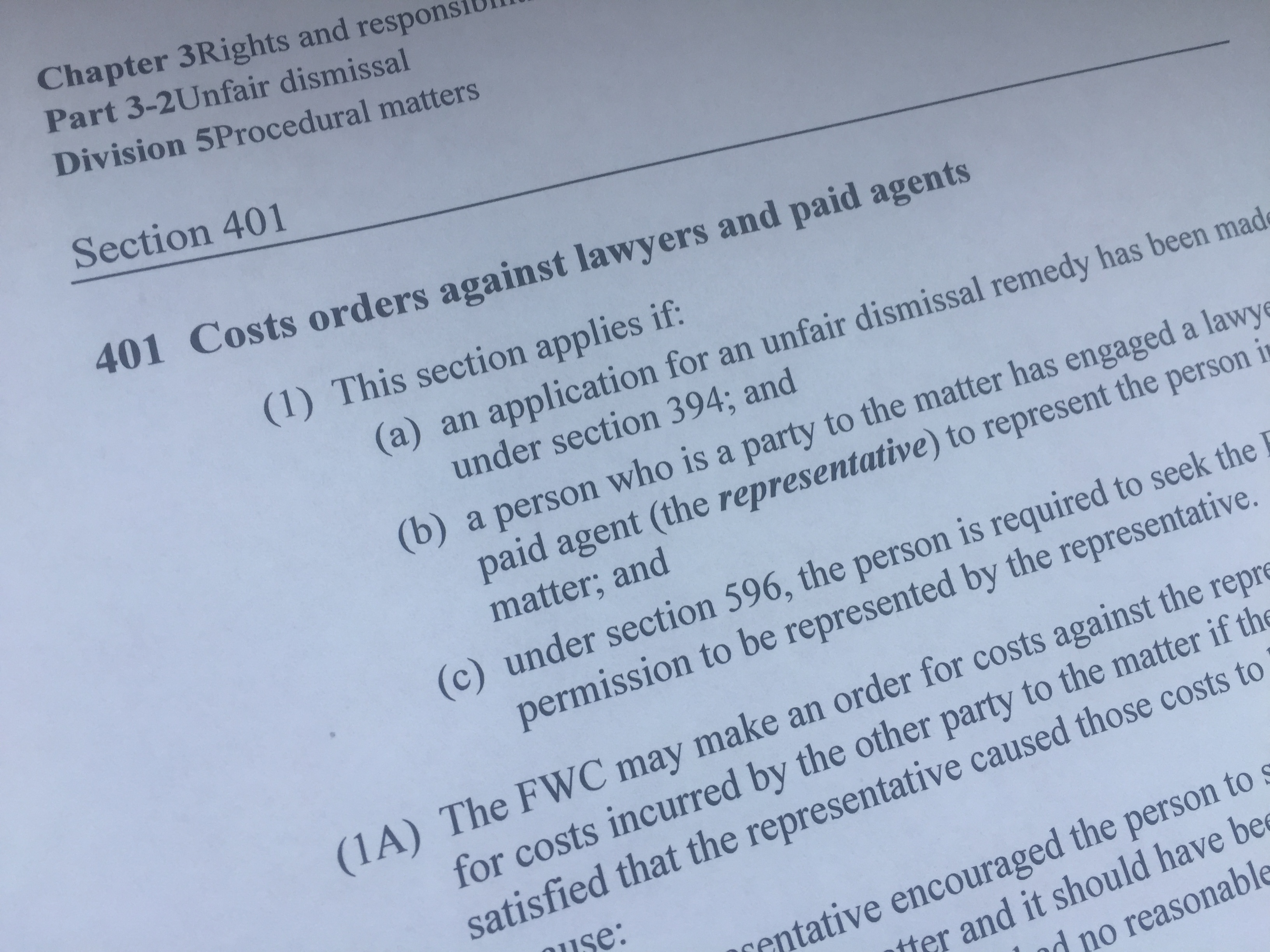
Following some emerging trends in representative conduct in the Unfair Dismissal jurisdiction in particular, the Fair Work Commission require broader powers to make costs orders, especially against lawyers and paid agents who bring, or continue, claims that  lack merit.

The Fair Work Commission’s power to make orders for costs under the Act are limited, primarily to situations in which an ‘unreasonable act or omission’ in the conduct of the matter causes costs to be incurred by the other party.  The threshold of ‘unreasonableness’ is high.  The traditional rationale is, that in a situation of power or resource imbalance, parties should not be deterred from litigation by the threat of costs orders. This is an essential feature of the ‘fair go all round’.  There would be limited utility in providing vulnerable employees with protection under or 3-2 of the Act, if access to litigation was inhibited by the same power imbalance that protection is designed to address.

FWC-imageHowever, the traditional disparity between parties has arguably shifted.  Access to free, or contingency based, representation, from unions, lawyers, or non-lawyer paid agents, is available to applicants to a level that it not available to respondents. And the involvement of these applicant representatives often mean that employers are uncomfortable proceeding without their own representation.  Efforts that have been made to simplify and lower the cost of termination disputes,  for the benefit of unrepresented parties, have encouraged the involvement of representatives acting outside the purview of the Legal Services Commissioner, and at times these representatives lack a thorough understanding of the provisions. In unfair dismissal applications, a push towards alternative dispute resolution has created an expectation on respondents that they should provide settlement options early in every single case, irrespective of merit.  Given the cost of legal representation for respondents, and the relatively limited compensatory level of each claim, it is rarely commercially sound to resist a claim past conciliation, even if the claim fundamentally lacks merit.  The high threshold of ‘unreasonableness’ in the costs provisions, has the effect of insulating applicants and paid agents from any consequences relating to the institution or continuation of unmeritorious claims.  Applications can be used to leverage a result commercially, with little regard for the actual provisions.   A divergence now exists between law in action, and law in principle.

File 30-10-17, 4 26 34 pmMeanwhile, Unions are also excluded from section 401 of the Fair Work Act, because they are not required to have permission to appear.  Costs orders cannot be made against them when they act as representatives for their members.  This allows Union representatives a considerable litigious freedom, with limited responsibility.  For many years Unions have benefited from the receipt of civil penalties awarded against employers by the Federal Circuit Court and Federal Court. Unions therefore, have enjoyed a unique position in which they hold an incentive to bring claims on behalf of their members, yet no disincentive against vexatious and unreasonable conduct.

This applicant power, and the divergence between legal reality and legal principle, flows back to the workplace. The legislative provision that currently dictates whether a dismissal is ‘harsh, unjust, or unreasonable’ is section 387 of the Fair Work Act. This is purposed as both a general deterrent to employers, as well as practical guide to the dismissal process.  However, employers are experiencing increasing levels of ‘shake down’ litigation, and are very aware of these commercial factors. This has created a disincentive to regard the section 387 guidelines in practice. As employers become more and more accustomed to having to settle claims, there is little point in performing dismissals fairly in the first place.  In this respect, the Act is failing to achieve its purpose.

65145986_lThere is no easy solution, but very slight changes in the costs jurisdiction may have the effect of addressing this emerging imbalance.  These changes should focus on regulating the conduct of representatives. Unrepresented applicants should remain largely insulated from costs orders.  However, a broader scope for costs orders against all representatives would be desirable to further the purposes of the Act.  These can be effected by three steps.  Firstly, added procedural obligations in the Fair Work Commission Rules, for representatives in relation to both the bringing, and resisting, of claims.  These may include representatives providing undertakings on the original application and response that the claim is brought or resisted with reasonable prospects of success. Further, instructions on a contingency or pro bono basis should be disclosed to the Commission, and parties making that disclosure should be compelled to apply to the Commission for permission to cease representation.  Fair Work Commission Conciliators and parties should be given broad power to apply to the Commission for intervention in the event that either the procedural obligations are breached, or if it appears that a claim has been brought without merit.

Secondly, the phrase ‘unreasonable act or omission’, in section 401 of the Act, should be defined to further include any breach of the new procedural obligations for representatives. This would broaden the powers of the Commission to make costs orders in specific circumstances, and encourage greater respect for the legal provisions from many paid agents and lawyers.

Thirdly, Unions should no longer be protected from costs orders by the Act.  Like all other agents in this space, they should be held responsibilities for any unreasonable conduct.

July 1

Unfair Dismissal or General Protection? A high pressure choice facing employee litigants

When National system employees are unlawfully dismissed from employment they will generally have a choice of which section under the Fair Work Act to make their application.  Was it an Unfair Dismissal, or was it a contravention of a General Protection involving dismissal?  There is considerable overlap in these actions, but the Fair Work Act insists that only one may be chosen, the choice must be made within 21 days, and the choice is final.   In employment law practice, coming upon a case where an inappropriate choice has been made is a weekly occurrence.  If settled at conciliation this mistake has no consequences, however if the matter proceeds, often this error can be the difference between success and failure.

At first glance the actions seem similar.  A dismissal is ‘unfair’ if the Commission hold it to be ‘harsh, unjust or unreasonable’.  A General Protection, on the other hand, is contravened if an employer takes any type of adverse action against an employee on unlawful grounds, which includes because of the employee the exercising, or proposing to exercise, a workplace right.

But despite the fact that the contextual factors giving rise to these actions are similar, the causes of actions themselves are radically different.

Unfair Dismissal is constrained by strict jurisdictional parameters – parliament very clearly intended this provision to be only open to a specific class of employees.  It is not available to people earning over $138,900 per annum, to people that have been employed less than six months (or one year in the case of small business employers), the person must be ‘dismissed’ in accordance with a specific statutory definition, it is not available in the case of a ‘genuine redundancy’, and it is not available to casual employees unless they have been engaged on a ‘regular and systematic basis’. These parameters are strictly enforced at the Commission.  In legal terms, they have no jurisdiction to do otherwise.

But once the jurisdictional hurdles are overcome, the Commission have a broad discretion to assess the dismissal holistically, and it is only required that the dismissal be ‘harsh’, ‘unjust’, OR ‘unreasonable’. In the often quoted words of High Court Justices Gummow and McHugh “a termination may be harsh but not unjust or unreasonable, unjust but not harsh or unreasonable, or unreasonable but not harsh or unjust.”   These concepts pre-date the Fair Work Act, and at common law it is well understood that an ‘unjust’ dismissal is one in which the employer lacked a valid reason, or in which the employee was not guilty of the misconduct alleged.  An ‘unreasonable’ dismissal is one in which the employer acted unreasonably in coming to the decision to dismiss, or the employee was not afforded adequate procedural fairness.  A ‘harsh’ dismissal is one in which the decision to terminate the employment, within all of the circumstances, is disproportionate to the gravity of the misconduct.   This common law meaning is neatly codified by s 387 of the Act.  Generally, a case will get over the line if the Commission finds any significant fault of this type.

These jurisdictional hurdles are absent for a General Protection application, however in contrast to Unfair Dismissal each of the elements must be proved. If adverse action is alleged in response to the exercise of a workplace right, the employee must clearly identify the workplace right, and demonstrate that they exercised, or proposed to exercise that right.  If this is done, the onus then falls on the employer to prove that the exercise of workplace right was not one of the reasons for the adverse action.  Significantly, however, the reverse onus in itself does not make the employee’s case.  If the employer can prove that the exercise of a workplace right was not a factor in the mind of the decision maker, as a question of subjective fact, then the case will fail.

Many cases would satisfy both, and many would satisfy neither.  In my experience the choice to go with a General Protections application is made either because of the jurisdictional limitations of Unfair Dismissal, or because of the limited scope of compensation available in an Unfair Dismissal application (capped at 26 weeks).  For these reasons, but in particular the high income threshold, General Protections have become the default stomping ground for disgruntled executives.  But in the chase for a larger compensation, many litigants don’t realise that their case may become harder to prove.

FWCOn the other hand, lower paid workers, especially those without representation, often rush to file an unfair dismissal application within the 21-day time limit without ever knowing or getting legal advice that the General Protection provisions may be more appropriate for their case.

In James Morphett v Pearcedale Egg Farm [2016] FWC 1940, the employee was dismissed for aggressive behaviour and offensive language during a workplace meeting.  The employee brought an unfair Dismissal application.  The employee had been angry because he had injured himself at work, and had been threatened with termination because the employer had not wanted the injury to go through work cover.  During the meeting he lost his temper and threatened the employer, resulting in his dismissal.  The Commission held that while the employee’s anger was ‘understandable’ the conduct was not, and ruled that the dismissal was not unfair.  But from the limited facts available, it is very clear that the earlier threat to dismiss was in response to a proposal to exercise a workplace right.  This breach would not have been cured by the employee later losing his temper and being dismissed.  Had he brought a General Protection application, he would have had a much greater chance of success.

CFMEU v Anglo Coal (Dawson Services) Pty Ltd [2015] FCAFC 157, is an example of the exact opposite.   The employee had applied for two days’ annual leave which was refused, and then threatened the employer that he would take sick leave instead.  Coincidentally, on the date in question the employee was genuinely sick.  The employee was sacked, due to the employer’s genuine mistaken belief that the employee was being dishonest in taking the leave.  The employee brought a General Protections application but failed, due to the fact that because the mistake of the employer was genuine, it could not be shown that they made the decision to dismiss him for the prohibited reason.  In spite of the onus, the employer was able to prove that there was no causal connection between the exercise of a workplace right and the decision to take adverse action.   The federal court noted the injustice, but specifically mentioned that an unfair dismissal action had been available to the applicant. Had the action  been brought this way a remedy would have resulted.  It was the applicant’s litigation strategy which had denied him relief.

In summary, an unfair outcome, irrespective of the reason, is almost always best dealt with in the Unfair Dismissal jurisdiction. However, unfair or unlawful intentions on the part of an employer often will be punished more thoroughly under the General Protections provisions. But each case will depend on its own facts. These two recent cases illustrate the dangers of making this assessment incorrectly.  Given the difficulties in this area, and the trouble many employees face in accessing expert legal advice, these won’t be the last.