May 16

Anti-social media: 4 ways to manage social media and cyber-bullying in the workplace

Whilst technology and social media have unquestionably provided many benefits to the modern workplace and opportunities for businesses to reach a wider audience, they have also presented dilemmas for HR managers and business owners when dealing with interactions between employees. With the increased use of the internet and social media, and the fact that almost everyone in the workplace now owns a smart phone and can access Facebook, Instagram and similar social media platforms 24/7, problems that used to be left at work when the day ended and everyone went home now follow people home after work hours, which can present huge challenges for employees and managers alike.

With 66% of the Australian population now on Facebook, 20% on Instagram and 17% on Snapchat[i], social media has become a huge part of many people’s lives. The impact that social media bullying has on children and teenagers has been well publicised, with many schools now introducing programs to educate students about cyber safety. However, the impact that social media and in particular, social media bullying has on workplaces has received far less attention.

In the last few years, social media has played a much larger role in bullying claims, unfair dismissal applications and workers compensation claims, with it now not being unusual for screenshots of social media conversations, statuses and comments to make their way to tribunals and Courts in support of employee’s claims.

Whilst many businesses are now taking steps to address bullying and harassment in the workplace, businesses should also be putting steps in place to address employee’s use of social media in and away from the workplace and implementing processes for employees to report anti social behaviour that they may be subjected to from other employees when using social media.

4 steps for employers to manage social media bullying

Social media and cyber bullying is often unfamiliar territory for many employers, however, there are steps that can be taken to minimise legal risk and ensure that the workplace is a safe environment for all employees.

  1. Implement workplace policies

The best action that employers can take is to develop bullying, cyber bullying and social media policies. A policy relating to bullying should include a definition and examples of both bullying and cyber bullying as well as what behaviour is appropriate and acceptable and what behaviour is not. The bullying and cyber bullying policy should make clear the consequences for failing to comply with it, such as warnings, suspension or termination.

Employers should emphasise that the conduct does not need to occur specifically at work. The Fair Work Commission has recognised that technology and social media has blurred the line between what is “at work” and what is not.

In Bowker & Others v DP World Melbourne Limited [2014] FWCFB 9227, the Commission held that the traditional meaning of “at work” may not necessarily apply to a cyber bully as comments made on social media (in this case, Facebook) only need to be accessed whilst the employee is “at work” to enable the employee to make an application for a stop bullying order under the Fair Work Act. This means that as long as the comments remain on social media and the employee is able to access those comments whilst they are at work, the employee will have the ability to make a bullying complaint to the Commission.

For this reason, workplace policies that are implemented must adequately address the fact that they will continue to apply even outside working hours and that employee’s will be expected to comply with the policy, otherwise disciplinary action may be taken against them.

When it comes to social media and the workplace, it is not just words that may be considered cyber bullying, but also a person’s actions. In Rachael Roberts v VIEW Launceston Pty Ltd [2015] FWC 6556, it was held that “unfriending” a colleague on Facebook could be considered to form part of bullying conduct. However, “unfriending” on its own is unlikely to constitute bullying, as in this case, it was the combination of other conduct that led to the Commission finding that the employee had been bullied.

  1. Develop a reporting and investigation process

Each workplace should develop a thorough reporting process and investigation process which is usually set out in a grievance policy. Because of the nature of cyber bullying, and the potential for it to occur outside of working hours, often the only way that employers become aware of any issues is if the employee tells them.

It is important to ensure that employees feel comfortable reporting issues to their supervisors and/or managers and that they are encouraged to do so. This means that supervisors and managers must deal with a complaint appropriately by listening, asking questions and showing empathy.

Having a policy that allows complaints to be made is vital to avoiding a bullying application being made by an employee. The Fair Work Commission expects that prior to making an application, the employee has exhausted avenues available to them to have the complaint remedied by their employer. If a business does not have a grievance policy in place, this can open the door to an employee making an application directly to the Commission without first providing the business with the opportunity to address the issue directly.

  1. Train managers and staff

Employers have a legal obligation to provide a safe workplace for their employees. This includes training and educating their employees regarding bullying and cyber bullying and what is and isn’t acceptable behaviour in the workplace.

If a business fails to train its staff on what is and isn’t acceptable, and an employee subsequently bullies another staff member, a business can be held liable for the employee’s actions. For this reason, it is vital that all staff are given training on appropriate behaviour in the workplace and how to deal with bullying and cyber bullying in the workplace. This will also assist in countering any claim that the employer is vicariously liable for an employee’s actions as it demonstrates that the behaviour was not condoned by the business and the business took reasonable steps to train staff about expected behaviour.

  1. Don’t ignore the issue

If a business does become aware that there is an issue between staff members or that comments or posts have been made on social media that are inappropriate, the business has an obligation to take immediate steps to address the issue.

Despite there being a tendency to want to ignore issues that crop up on social media given they can be tricky to handle, usually apply to out of work conduct and can sometimes involve petty disputes, if a business is on notice that there is something wrong and does nothing about it, there is a very strong possibility that the employer could be liable for any damage that is caused to the bullied employee’s health, if a claim were to be brought by them.

[i] https://www.socialmedianews.com.au/social-media-statistics-australia-january-2017/

June 24

What changes are coming on 1 July?

With the new financial year fast approaching, businesses and human resource managers must now turn their minds to workplace planning and employee entitlements, having regard to new changes that will come into effect on 1 July 2016.

National minimum wage

As is required every year, the Fair Work Commission has reviewed the national minimum wage and has ordered a modest increase of 2.4%.

The national minimum wage was previously $656.90 per week or $17.29 per hour.

From 1 July 2016, the national minimum wage, which applies to employees who are not covered by an enterprise agreement or modern award, will be $672.70 per week or $17.70 per hour. This is a pay increase to the country’s lowest paid workers of $15.80 per week.

The Australian Council of Trade Unions (ACTU) had asked the Fair Work Commission for a $30 per week or 4.6% increase, whilst the Ai Group requested a rise of $10.50 or 1.6%.

The new rate of $17.29 is the lowest amount an adult employee can be paid if they are not otherwise covered by an enterprise agreement or modern award.

Award wages

As of 1 July 2016, minimum wages in all modern awards will increase by 2.4%, reflecting the same percentage increase as the one which applies to the national minimum wage.

This means that all award covered employees who are receiving minimum pay must receive a pay increase of 2.4%. Modern awards will be amended by the Fair Work Commission to reflect the increases to wages.

High income threshold

The high income threshold will increase from $136,700 to $138,900 on 1 July 2016.

This means that employees who earn over $138,900 will not be protected from unfair dismissal. Further, this could mean that employees who were previously above the threshold of $136,700 may no longer be above the new threshold amount and therefore, they may now be able to bring a claim if their salary has not been slightly increased.

Employers and human resource managers should carefully review the salaries of those staff who are close to the high income threshold, with serious consideration as to whether they should be increased above $138,900 in order to avoid the risk of an unfair dismissal claim.

It is important to remember that compulsory superannuation contributions are not included in the calculation of an employee’s remuneration for the purpose of the high income threshold. However, other items, such as the value of a car, work laptop and mobile phone can be included if properly documented by the company.

Things to watch

Over the next six months, businesses should also keep an eye out for:

  1. Changes to awards as part of the 4 yearly review of modern awards. At this stage, no date has been set by the Fair Work Commission as to when changes such as those relating to excessive annual leave accruals will be made to modern awards;
  2. Changes to the Fair Work Act as a result of the 2016 federal election. Both the ALP and the Coalition have stated that they will increase maximum civil penalties for breaches of the Fair Work Act, including underpayments. The Coalition has proposed to make amendments that will see franchisors, parent companies and directors liable for breaches of the Fair Work Act by their franchisees and subsidiaries, whilst the ALP has proposed to make it a criminal offence for those who deliberately exploit overseas workers.
January 18

Redundancy

A recent decision of the Fair Work Commission regarding redundancy entitlements could have some unfortunate consequences for employees and, in my opinion, in the long term for business and the economy. In Compass Group (Australia) Pty Ltd  v National Union of Workers; United Firefighters’ Union of Australia [2015] FWCFB 8040 the Full Bench of the Commission held that a group of employees on fixed term contracts were not entitled to severance payments even though the employees had been in many case engaged on a series of fixed term contracts for a number of years. The employees all were involved in providing catering and hospitality services to the Department of Defence as part of a contract between Compass Group and the Department.  The employer concerned had a regular practice of terminating the employment of employees when a contract of the employer’s ended. Because of this regular practice the Commission held (and this is probably strictly correct at law) that the terminations were the “ordinary and customary turnover of labour” for that employer and no redundancy benefits were payable.

Under the redundancy provisions in the National Employment Standards redundancy payments are not required when a termination is a result of the “ordinary and customary turnover of labour”.

A direct consequence of this decision is likely to be that that some employers will be encouraged to have high turnover of labour, use fixed term and casual arrangements even more than is currently the case. This will jeopardise an already vulnerable group of employees.

Unfortunately, as managers are often rewarded for short term financial targets with little regard to long term benefits, many managers will be encouraged to embrace this short term cost saving without regard for the long terms interests of any employer in developing a skilled and loyal work force. It also impact the commitment of many the employees (who have no reason to believe a position will continue).

In my opinion the government should consider responding to this decision by amending the National Employment Standards so that only genuinely short term fixed contacts and casual employees (who have received casual loading) are excluded form the right to redundancy payments if their employment ends in circumstances of redundancy.

June 3

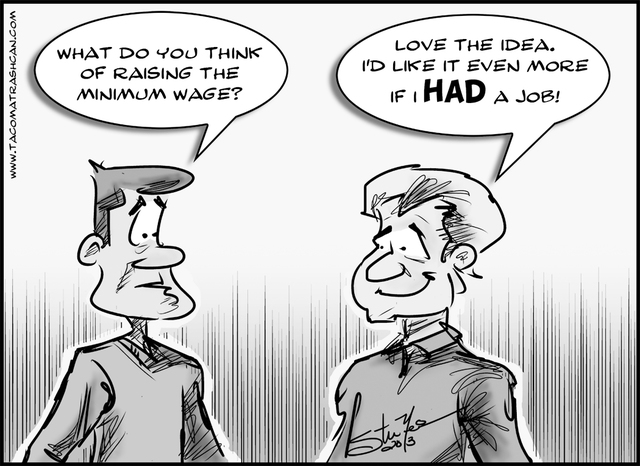
FWC minimum wage increase – what does it really mean?

The announcement by the Fair Work Commission yesterday to increase the minimum wage was uncontroversial.   The new rate of $17.29, will represent a $16 increase per week for full time employees.

But what’s interesting about this is the way that it’s been described.  This article suggesting that “Australia’s lowest paid workers” will have an increase from $640.90 to $656.90.  Strictly speaking, this is a little misleading – as full time minimum wage employees are not actually ‘australia’s lowest paid workers’.  There are two separate reasons for this.

Firstly, casualisation of the workforce has been the latest economic trend for employers.  For casual workers a key issue is how much work they are actually offered, and not having access to some of the fundamental securities such as personal leave, paid public holidays and  annual leave which many of us take for granted.  The traditional polarity of employed vs unemployed is no longer the paradigm.  And therefore the traditional measures of minimum wage and percentage unemployment does not tell the whole story.  Under-employment is an issue which forces many families under the poverty line – not want for minimum wage per hour.

The second issue is a lack of proper enforcement.  The cash economies within hospitality, retail, agriculture and many other key domestic industries pay little attention to either the modern awards or the Fair Work Commission’s announcements.  It’s business as usual.  Fifty dollars per day and “as much coffee as you can drink” doesn’t add up to $656.90 very quickly, especially when a lack of superannuation guarantee and workers compenstion coverage is taken into account.   While a small minority of employees may regard cash payments as preferable, to avoid losing unemployment benefits, youth allowance or ausstudy, when the sortfall from minimum entitlements is actually calculated they are very rarely better off.  In my experience the majority of cash employees are simply not given the choice.

The Fair Work Ombudsman has their work cut out dealing with extreme cases such as this.     Investigating every single complaint is onerous, especially when many employees are unwilling to follow through with their complaint.   Even if the Ombudsman was able to audit every business in Australia every five years, this would miss a vast majority of small cash businesses, which have life cycles much shorter than this.

While I support an increase in minimum wage – I don’t see this as the most pressing issue relating to poverty in society or even the key step to be taken by the industrial relations system in Australia to protect vulnerable workers.

cartoon-minimum wage*image from tacomatrashcan.com

April 10

Happy Easter – as the penalty rates debate boils over

The penalty rate argument has been steadily brewing since the Coalition took office 18  months ago, spurred on by the recent decision of Restaurant and Catering Association of Victoria [2014] FWCFB 1996 which I discussed in this post.  It’s not surprising that the penalty rates argument would come up over the Easter Weekend where NSW and Victoria both have gazetted four public holidays in succession.   As with so many aspects of workplace law, the public conversation has been fueled heavily with emotion and political speculation, leaving the real issues stretched to opposite extremes.  But the debate reached fever pitch after a very poorly conceived advertising campaign by the ACCI.    Peter MartinJenna Price, and Heath Aston have all published opinion pieces in recent days in the Sydney Morning Herald expressing the community’s distaste.

Before entering the debate I should express my gratitude for being one of the many Australians that didn’t have to work over the Easter weekend.  (Although of course being  self employed, making the choice not to work also meant that I didn’t earn any money).  I should also express gratitude for the many people that did work to make my long weekend enjoyable – making cappuccinos, working in shopping centres, risking life and limb to referee football games, and driving the ambulances that I thankfully  didn’t happen to need.  Thank you to all and Happy Easter.

But I also feel the need to assert that the debate is being blown out of hand.  The ACCI can lobby Canberra as much as they wish on this, but it will make little difference other than to antagonize the community.  This is because the current Coalition government are simply unable to make this wide-scale change to workplace law (including changes to the currency or content of the Modern Award system) without convincing the senate, which appears to be strongly against almost all of their attempted social and financial reforms.  If the current media and polls are to be believed, the Coalition’s popularity is suffering, and at this stage just managing a lower house majority at the next election will require an ambitious turnaround, let alone achieving control of the senate.   But even if they did somehow pull off an electoral miracle in 2016,   memories  are fairly fresh of the political fate which met the last Howard Government’s attempt to capitalise on a senate majority with radical workplace legislation.    In real terms, the political debate over penalty rates is more in the field of business vs community rhetoric than any prospect of real legislative change.

The reality is that without major changes to the Fair Work Act, the Fair Work Commission will retain control over the modern awards.  Their decision in the Restaurant and Catering case in relation to the Modern Restaurant Award demonstrates only very small signs of a careful attitudinal shift – and only in recognition of the limited modern social difference between Saturdays and Sundays.  There has been no suggestion that they are ready to jettison penalty rates altogether.   The Commission accepted that for senior employees, the Sunday penalty represented a significant segment of their  weekly income, and only reduced the Sunday penalty rate for Introductory level and Grade 1 employees in the Modern Restaurant Award from 150% to 125% (to be the same as the current Saturday penalty).  Employees classified as Grade 2 and above still receive the Sunday rate.    In layman’s terms, this has meant that only employees whose duties are restricted to clearing tables, washing dishes, cleaning, or who are inexperienced trainees, are effected by the change – and this change is only a 20% overall reduction for one day.  For anyone who serves a customer, makes a drink, coffee, or prepares any food the status quo has been retained (the vast majority of staff in the restaurant industry are either Grade 2 and above, or rapidly on their way to becoming Grade 2 or above).  This reflects the Fair Work Commission’s assessment that those employed on a significant basis within the industry should not be subject to a reduction in income.  For the minority concerned this is a relevant change, but hardly a social revolution.

The socio-economic and political  discourse this issue inspires is always heated. (Martin’s intelligent points on class and ‘co-ordinated leisure’ are particularly engaging).  But to boil this issue down into a polarized debate between human rights and economic progress misses one of the key issues – the incentive value that penalty rates hold for workers.  Penalty rates do not exist just to compensate the worker for their social losses, they partly serve to act as an incentive to get people to work the shifts the rest of society requires.  Conservative free market politicians might wave unemployment figures around as if this incentive is no longer necessary, but ask any restaurant owner or hospital manager how difficult it is to staff their workplaces on weekends in the current environment, let alone if penalty rates are jettisoned.   There is no coincidence that the professions that currently face mass skills and qualification shortages (such as chefs and nurses) are also the ones that are expected to ply their trade 24/7.   This is yet another area of industry in which the casualisation of our workforce has back-fired.  If the price is not right, sought after workers can simply say no.

While I always enjoy a bit of public hysteria about workplace law – I don’t think the ACCI should be counting their chickens on penalty rate reform any day soon.


* Helen Carter is the Director and founding solicitor at PCC Lawyers, a team of employment practitioners based in Sydney, with many years of combined knowledge and experience in workplace law, industrial relations, workplace investigations and training.  They provide a high standard of excellence and an exceptional level of personal service to a variety of clients in the Sydney metropolitan area, Central Coast, regional NSW and interstate.


November 17

The importance of express terms in Contracts of Employment and Enterprise Agreements

The importance of express terms in Contracts of Employment and Enterprise Agreements

A presentation on 16th October 2014 on both Contracts of Employment and Enterprise agreements.

Employment contracts

In Commonwealth Bank of Australia v Barker [2014] HCA 32, the High Court held that the implied term of trust and confidence does not exist.  This decision overruled the two federal court decisions below it, as well as the current English authority, Malik v Bank of Credit and Commerce International SA.   The thrust of the High Court’s reasoning  as that an implication of a term at law requires the term to be ‘necessary’ for the performance of the contract.  It is not enough that it simply be ‘reasonable’.

The significance of this decision is that an employment contract is like any other contract, and is to be interpreted according to the words of the document.   This is significant in the  that  traditionally employees framing actions in contract against their employers have often relied upon implied terms, choosing to leave the express contractual terms to one side.  The decision in Barker suggests that this may now be a mistake.

From the employer’s perspective, this relaxed attitude toward express terms frequently leads to some lax practices.  Express terms concerning things such as KPIs, incentive schemes, and right to renewal have been construed by courts strictly, and they have shown themselves to be unimpressed by evidence of contrary intentions.  Courts are demonstrating no desire to treat contracts of employment differently to other contracts, and relying on the statutory regime behind the contract of employment is a mistake for both employees and employers.

The message is, get your express terms right.  Don’t put anything in your contract that you can’t do, and don’t rely on implied terms to prevail.

Enterprise Agreements

EA’s can be a nightmare to some employers.   But often they can be fantastic in offering flexibility, especially in getting around some of the problems presented by the modern awards, and some cultural benefits to the workforce in bringing people together.

But they can be a significant issue if they are not done correctly.

There have been some developments recently.  Every employer wants to retain the right to change workplace policies if and when they see fit.   But there have been some recent decisions in which an employer, in attempting to alter workplace policies, have been hauled before the Fair Work Commission under dispute resolution clause, and have been held up from changing their policies.  One case involved a policy relating to mobile phone use policy, where the Dispute resolution clause in the Enterprise Agreement gave the FWC the right to concililate and arbitrate on ‘terms and conditions’ of employment: not just on the employment terms governed by the Enterprise agreement, Modern Award or the National Employment Standards.  This is a huge mistake, because effectively it is an invitation to the Fair Work Commission to become involved in operational matters at work.

Another decision related to a No Further Claims clause.  Every Enterprise Agreement has a clause like this, as they perform an important function in preventing ongoing claims from either side – however in one instance the clause was held to prevent the employer from changing their motor vehicle policy – as it was held to have relationship to the remuneration of the employees.

The lessons :  while EA’s can be a great vehicle for flexibility when you are dealing with a good workforce  – it is absolutely essential that the agreements dispute resolution does not allow the FWC to arbitrate, and secondly is based on what is covered by the modern  award or Enterprise Agreement, and does not go more  broadly into terms of employment.  If you do that, you are going to end up with the Union or the Fair Work Commission trying to tell you how to run your business.

Once the agreement is madeThe importance of consultation

No one likes having these difficult conversations, especially in the context of an employee not receiving a benefit or entitlement that they expect – but it is extremely important that consultation takes place.  Not only is the consultation process legally required, but a calm, reflective consultation can actually take the heat out of a situation, and will often reduce your likelihood of having an industrial problem by approximately 90%.   View it not as a difficult conversation to be endured, but rather as an opportunity to connect with them, diffuse the situation and begin the process of resolution.